
Today’s post on one of the oldest books in LJMU Special Collections was researched and written by Jamie-Lee Purnell, a second year History and English student currently on a work placement with us.
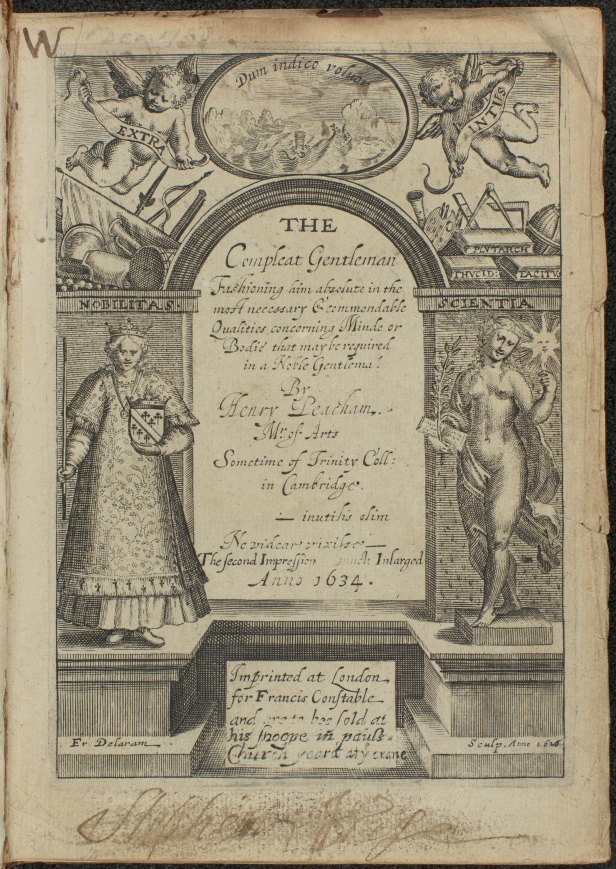
Henry Peacham (1576-1644) studied at Cambridge University as a Master of Arts. Graphice, his first essay in literary work was a practical treatise on art. It was entitled ‘Graphice, or the most auncient and excellent Art of Drawing with the Pen and Limning in Water Colours’. These ideals within art, mind, body and soul carried on into future essays such as The Compleat Gentleman, a handbook intended to be a guide for young men of good birth. He illustrates the importance of traditions in courtesy books that dealt with ideals, education and conduct befitting a gentleman or lady of the court. Concepts and practices of nobility were common during the 17th century and this book endeavours to encompass the ideals of the complete gentleman.
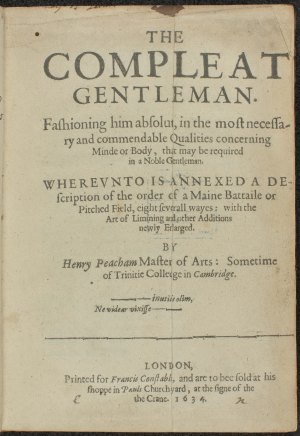
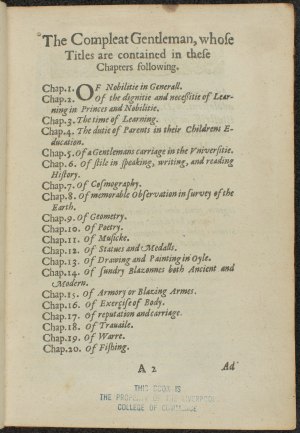
It is interesting to note that most of Peacham’s works are quite unusual for 17th century literature. Most of his work survives in manuscript due to the precious illustrative designs. They comprise largely of emblems which were used as mottos and verses designed to serve as morals for the purpose of self-reflection. The Compleat Gentleman’s first plate has elaborate figures of Nobilitas and Scientia. The engraving is by Francis Delaram (1590-1647) who was renowned for royal portraits. The handbook is full of expressions of his theories on education and includes a table of contents. This demonstrates Peacham’s wide range of interests including practices of nobility, parenting, eloquence in writing, speaking, reading, history, cosmography, poetry, music, art, exercise and fishing.
It is mostly interesting to see that Peacham’s concept of nobility is not just for the rich. Given that 17th century gentlemen were considered to be opulent and members of the aristocracy, he argues that “riches are an ornament, not the cause of nobility”. Nobility in Peacham’s eyes is an art that is redeemed within, and riches are materialistic. Therefore, anyone can strive to be a gentleman no matter their individual level of opulence.
New understandings of knowledge and reasoning are well detailed in the Cosmology chapter. Peacham gives a nod to the importance of history, religion and imperialism and explains that without history man would be ignorant to knowledge and growth. He also dives into the new-found 17th century sciences and illustrates the concepts of astronomy and geological aspects of the world; essential new ventures for the modern gentleman to be aware of.
The handbook has been carefully edited and well preserved and is a must read for any student who is studying in humanities or at their own leisure; whether that be comparing the ideals of gentlemen in the court to women of the 17th century or to see how society has changed vastly over the centuries. As others have noted an index would be handy to locate specific information but this does not detract from the concepts and beautiful illustrations within Peacham’s handbook. This literary treasure is located within our own Aldham Robarts Library in the Special Collections & Archives Reading Room and can be easily accessed by students. The Special Collections & Archives department houses many historical documents, art, literature and more for ambitious students who wish to dive into history for excellent primary sources and expand their historical knowledge.
Edwards, J. The Scottish Historical Review, Vol 4, 1907, (Edinburgh University Press).
MacClintock, C. Readings in History of Music and Performance, (Indiana University Press).
Peacham, H. The Compleat Gentleman, 1634. LJMU Special Collections 395.1232 PEA
 LJMU Special Collections & Archives