
Hello.
That’s a nice and simple greeting isn’t it? Just picture a smile as I’m saying it so you know I’m actually friendly.
Anyhow, my name is Jade and I’m introducing myself to you because I am one of the new interns that is working with LJMU over the Summer period to help organise and produce an exhibition along with other materials surrounding the animal world during the Victorian period/19th century.
The exhibition is so-far called “Walking with Victoria’s Animals Through Time”. This name may adapt along the way but it’s ok because me and my fellow intern, Roisin, plan to regularly update you on our journey (through time, hehe).
So, a little bit about me. I have just completed my first year studying at Liverpool John Moores University in Media, Culture and Communication as I have a real passion for media in all of its forms. At the beginning of the academic year, one of our seminars was to go down into the archives to look at some ‘Femorabilia’ such as Jackie, which really sparked my interest. Some of you might remember it from the olden days (kidding) but nonetheless, looking at the magazines was fascinating for me. I felt closer to something once a thriving part of consumerist culture yet, unfortunately, never made it to my generation.
The internship is perfect for me: quiet, with solidarity (apart from Roisin, but I like her so it is ok) and the main part being the unique ability to work with amazing artefacts from another lifetime. Oh and let’s not forget the pay, student loans are not going to get me through summer but this job might just do it! (joking). The only downside is the igloo I have had to build in order to stay warm in the “temperature controlled environment”. Yay.
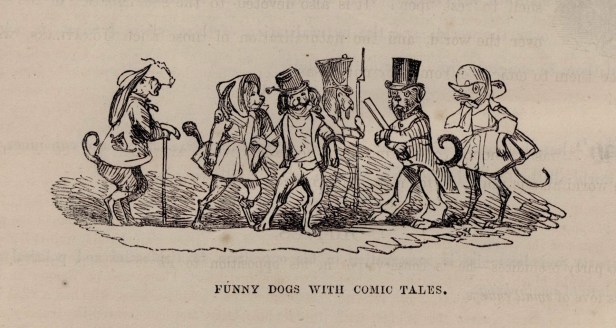
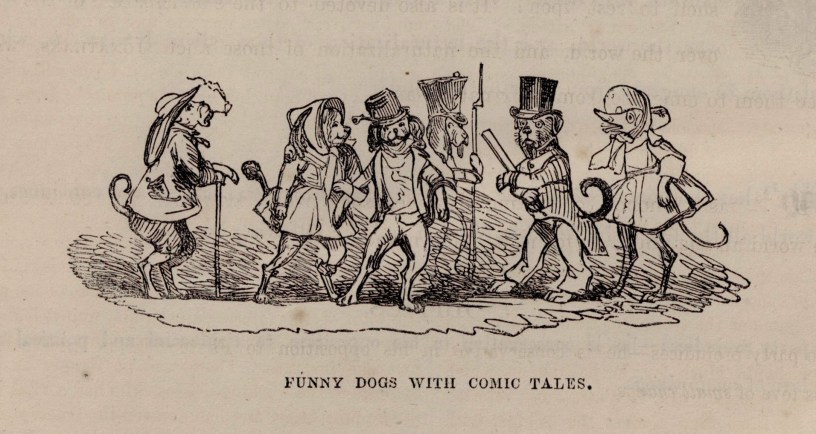
Above is a digitized image made with help from my lovely supervisor, Val. The extracted image is from Punch’s first publication in 1841 (show of hands for those who remember this period, well done for reading this). It’s called Funny Dogs with Comic Tales showing dogs acting as humans, dressed as humans and interacting as humans. However subtle, there are expressions shown in each of the faces of the ‘people’ (can we call them that?) and they indicate a sense of conflict between one-another. I find great satisfaction of Punch’s satirical humour, metaphorically insulting people – especially politicians. The ‘politician’ part is just a little bit too relevant for us Brits right now. A great example of this is a funny image located on page 139 of the 1841 periodical – have a giggle on me (hint: the page is literally peacocking at you and it tells a funny s-tory).
Cutting to the chase – I thought to include the image because of its comedy, and if you haven’t figured it out from my writing style yet: I like to be relaxed and attempt to be funny. It would actually be amazing, for me, if you could comment on the writing style along with what you hope to see in the future (assuming you ever come back) meaning we can tailor everything to you!
Periodicals such as the Punch collection offer more than just insight into the past lives of our ancestors: they build a bridge to contemporary society. Punch may have been one of the influencers of contemporary children’s television: animals portraying civilised human beings. Would books such as: The Wind in the Willows really have been printed if it weren’t for the success of Punch? Would TV shows featuring animals as metaphors such as the likes of Looney Tunes be a part of our (namely, Roisin and my) childhood?
Regardless of this fact, animals have had quite the history within the Victorian era/19th century and it is our job to reveal to you just what happened to the image of the ‘animal’ within this period. As previously mentioned, this will include the production of an exhibition within John Moores’ Aldham Robarts Library along with other things such as an online gallery accessible to LJMU students and an audio tape with information to accompany the exhibition.
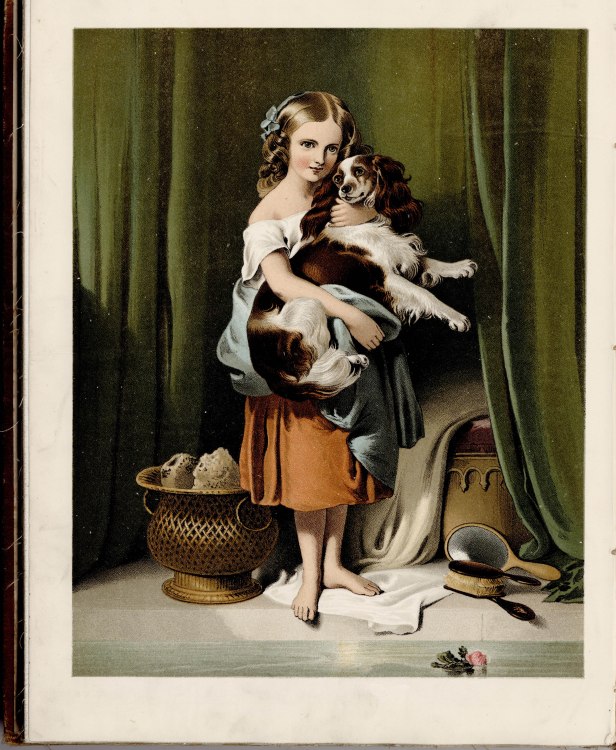
Here is a nice image called Beauty’s bath, by Sir Edwin Henry Landseer in 1847. A girl holding her dog (cute), commonly mistaken to be Queen Victoria and Dash (her favourite dog, BTW) but is actually Miss Eliza Peel with dog, Fido. Enjoy.
Thanks for reading this far and don’t forget to comment thoughts and opinions – it helps us (me) a lot for future posts!
Ta-ta for now.
Jade
P.S. Head over to Roisin’s blog post for an information rollercoaster about an image called Duke of Sutherland’s Children by Sir Edwin Henry Landseer, again, and why she chose this image!
References:
Mayhew, H and Lemon, M. (eds.) (1841) Punch. London: Punch Office. p. iv.
Mayhew, H and Lemon, M. (eds.) (1841) Punch. London: Punch Office. p. 139.
Pictures by Landseer. (1882) London: Thomas Nelson and Sons.
 LJMU Special Collections & Archives
I love your writing style! Maybe ease up on the content in brackets a little bit (just a little, most of it was perfectly in place) but otherwise I really enjoyed it and will definitely read more!
LikeLike