
Hello!
This week Jade and I have received two more Victorian books that Val, our supervisor, kindly ordered for us on our request. The books are called Animal Sagacity (1868) and Anecdotes of Animals and Birds (1880). Both books contain short stories and images surrounding animals. The images are black and white illustrations, with Harrison Weir being the main contributor. His work can also be seen in other Victorian periodicals such as Illustrated London News. The new additions to our collection incorporate all elements of our project and there is even a print of an RSPCA certificate with a picture of Queen Victoria in the corner, on the inside cover of Anecdotes of Animals and Birds. This further supports our existing knowledge of the Queen and the RSPCA greatly influencing a holistic approach towards animals, with the message being spread through literature.
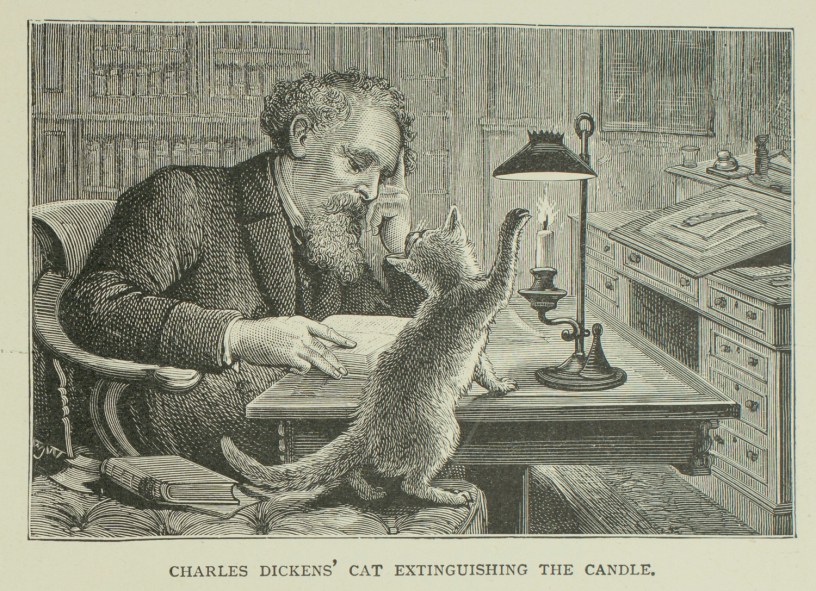
Including new material meant repeating the activities of the first couple of weeks of the internship in the form of digitisation and metadata processing. We have now added to our portfolio of animal imagery with a selection of illustrations from Animal Sagacity and Anecdotes of Animals and Birds. I have chosen an image from the latter, entitled “Charles Dickens’ Cat Extinguishing the Candle”.
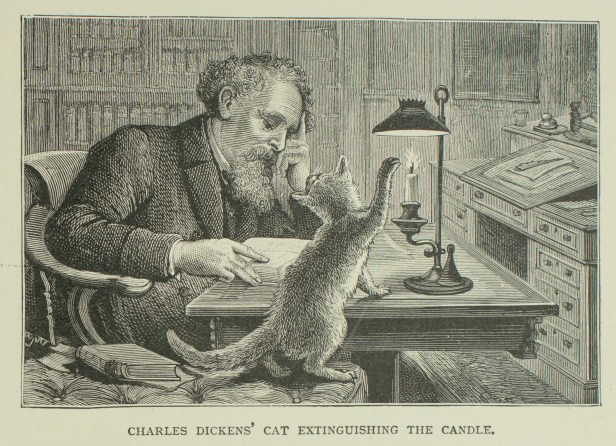
The title is self-explanatory, however I have chosen this image for the sense of the relationship between Dickens and his cat. Imagine it is late at night and the writer, weary and dozing at his desk, has nodded off before blowing the candle out and heading to bed. The cat has taken a protective approach and looks out for his master with an action that, if unseen, will remain secret: a notion adding to the genuineness of his deed. The cat’s back is facing the viewer, leaving his expression to the imagination, yet one might tell from the slant of his head that he could be affectionately looking at Mr. Dickens with sympathetic eyes. I say sympathetic as humans cannot enjoy falling asleep wherever they wish in the same way as our feline friends. Despite the charm of this image, it cannot be denied that this scenario is unrealistic and so some poetic licence is afforded in order to fully enjoy “Charles Dickens’ Cat Extinguishing the Candle”, a feature which defines its magic.
Conversely, as with all artwork, other interpretations of this image are valid. For example, although still centred on friendship, could Charles Dickens actually be awake and his cat is not being caring but in fact cheeky? The position of Dickens’ right hand, as if he is about to turn a page, suggests this interpretation to be true. In an act of menace, the cat, excluded from his master’s attention, is extinguishing the candle to cause distraction. The slant of his head, previously understood as tenderness, is a movement of mischief.
This image leaves the viewer curious for the next scene; what happens when the candle is extinguished and the room goes black? Does Dickens carry on snoozing and the cat curls up beside him? Or does he look up from his book in immediate surprise and annoyance? Either way, each question presents the core theme of friendship, the difference being the various elements of having a friend; someone to care for you, and someone to tease you.
Roisin
x
 LJMU Special Collections & Archives
His daughter, Mamie, noted in „My Father as I Recall Him“:
On account of our birds, cats were not allowed in the house; but from a friend in London I received a present of a white kitten — Williamina — and she and her numerous offspring had a happy home at “Gad’s Hill.” … As the kittens grow older they became more and more frolicsome, swarming up the curtains, playing about on the writing table and scampering behind the bookshelves. But they were never complained of and lived happily in the study until the time came for finding them other homes. One of these kittens was kept, who, as he was quite deaf, was left unnamed, and became known by servants as “the master’s cat,” because of his devotion to my father. He was always with him, and used to follow him about the garden like a dog, and sit with him while he wrote. One evening we were all, except father, going to a ball, and when we started, left “the master” and his cat in the drawing-room together. “The master” was reading at a small table, on which a lighted candle was placed. Suddenly the candle went out. My father, who was much interested in his book, relighted the candle, stroked the cat, who was looking at him pathetically he noticed, and continued his reading. A few minutes later, as the light became dim, he looked up just in time to see puss deliberately put out the candle with his paw, and then look appealingly towards him. This second and unmistakable hint was not disregarded, and puss was given the petting he craved. Father was full of this anecdote when all met at breakfast the next morning.
LikeLike