
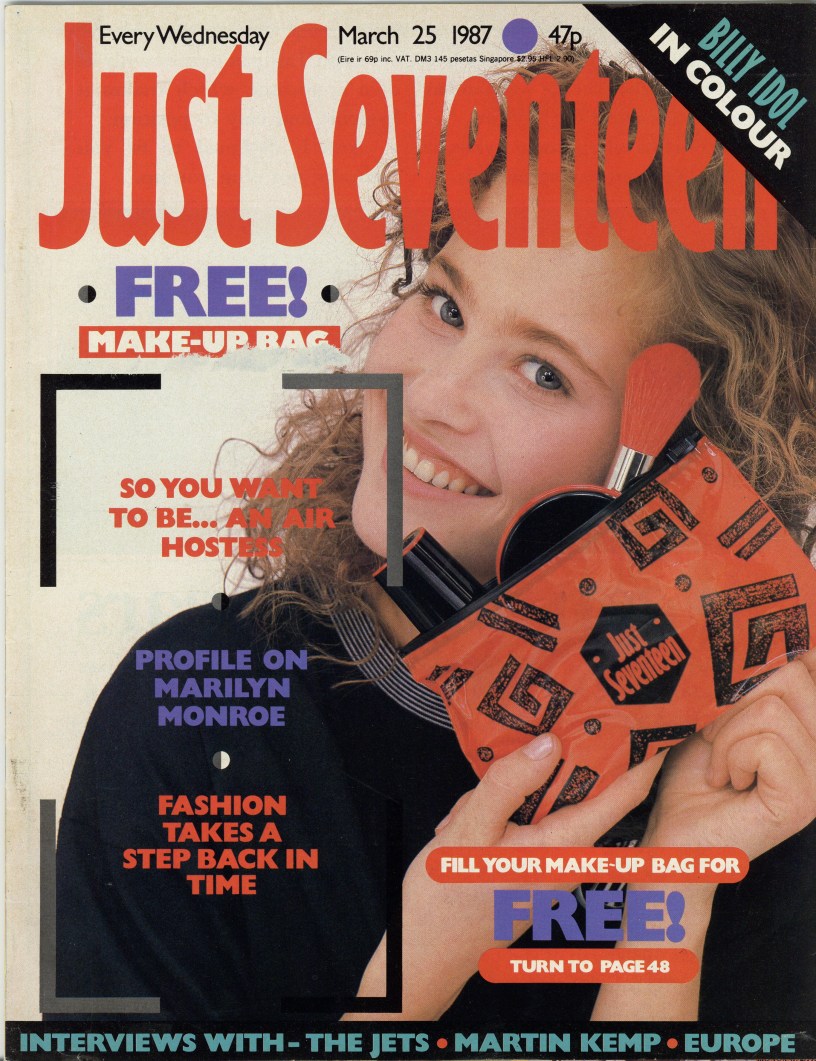
The first time I read Just Seventeen I was ten years old. I bought a copy with my pocket money and my mum was horrified; “do you know what that stands for? It’s Just Seventeen, this is just for seventeen year olds!” I managed to keep that magazine hidden at the back of my CD drawer for years, sneaking it out occasionally to look at its exciting, forbidden secrets. I only wish I could remember what they were!
This week I got to relive my early excitement over reading the magazine, only this time it was encouraged rather than forbidden! I have just started an internship working with the Femorabilia collection and over the summer I will be working with another intern, Rosie, on a project to catalogue domestic tasks in girls magazines like Just Seventeen, Jackie, and Mates. We have a lot of exciting work coming up and we will keep you updated week by week, but I should introduce myself for week one:
I’m Katie and I am an MRes English student at LJMU, researching early twentieth century American women’s magazine writing. I am particularly interested in depictions of race and marriage in magazine short fiction and how magazines promote reading through things like book reviews.
I was really pleased to be given the opportunity to work on this internship and get to know the Femorabilia collection. I was drawn to apply because I am keen to broaden my experience of working with periodicals, and to learn some new skills in digitising and cataloguing archival materials. This week Rosie and I started to familiarise ourselves with the collection and the tasks that we will be doing over the next few weeks, like uploading the Femorabilia catalogue to the library’s the fancy new online catalogue system.
Most importantly though, we read and I couldn’t wait to get my hands on Just Seventeen without getting told off! I read a selection of magazines from 1987 and started familiarising myself with the tone of the magazine and its regular features, as well as the finer details such as the frequency with which Spandau Ballet, and specifically Martin Kemp, were referenced (it’s a lot). In the magazine’s opening pages there was a regular feature called Frontline which reviewed new releases from the world of pop culture; singles, TV highlights, celebrity gossip, what Martin Kemp had been up to, and what Martin Kemp’s girlfriend made him for dinner (look out for another blog post on this, there’s so much to say about it that it needs its own post!)


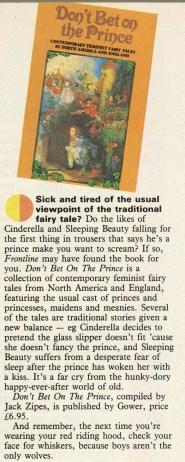
Since this internship asks us to think about domestic tasks in girls’ magazines, I was struck by the emphasis on leisure time that Just Seventeen seemed to promote in these round-ups, and as a literature student I was particularly interested in the book reviews I found. I learnt this week that the Femorabilia collection has been curated with an emphasis on magazines that feature fiction and I am fascinated by the ways that fiction functions alongside other content in magazines, as well as how magazines promote other fiction. I was drawn to a review in the March 25th 1987 issue of Just Seventeen of Jack Zipes’ edited short story collection Don’t Bet on the Prince. It is described as ‘a collection of contemporary feminist fairy tales from North America and England’ and Frontline celebrates its promotion of alternatives to traditional romance stories for girls, or at least for girls who remember to maintain their facial hair (or ‘whiskers’): ‘because boys aren’t the only wolves.’
Dodgy ideas of what feminism is aside, this got me thinking more about the sorts of reading practices that magazines promote, and I think this will be something interesting to keep thinking about in relation to magazines aimed at teenage girls. I’m looking forward to reading more as the internship progresses, and I’ll be thinking about how reading and domesticity are interrelated across the Femorabilia collection; where does reading for pleasure fit alongside reading for, say, improving domestic knowledge? At first glance, Just Seventeen seems less interested in securing the domesticity of its young readers than a magazine like Jackie for example, but it is not entirely absent of the ideals of traditional domesticity. Martin Kemp wasn’t cooking his own dinner after all…
By Katie Taylor
-All images from Just Seventeen March 25 1987.
 LJMU Special Collections & Archives