

If you’d have told me two weeks ago that I was about to start spending late nights Googling Martin Kemp, scrolling through his Twitter feed, and obsessing over his 80s hairstyles then I’d probably have dismissed you with the wave of a hand. Yet, here I am; I now follow Kemp and his wife Shirlie (formerly Holliman) on Twitter, and as I write this Pepsi and Shirlie tunes are playing in the background (I’m just not in a Spandau mood, okay?). And Just Seventeen is to blame. As we were reading through the Femorabilia collection and cataloguing domestic tasks in the cold, cold reading room this 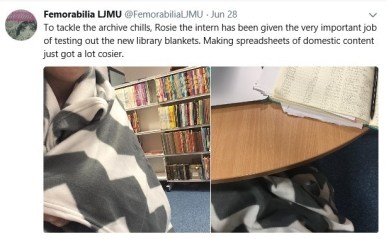 week, I came across a piece that I just can’t get out of my head. I mentioned it in last week’s blog post so this post will be (mostly) about what Shirlie Holliman cooked Martin Kemp for his dinner in 1987.
In the 18 March 1987 issue of Just Seventeen, the regular ‘Frontline’ feature included a brief item on behalf of the magazine’s ‘cookery department.’ I’m unsure of how fruitful a department this was since the only other kitchen-related item I have come across so far is a photograph of the grotty staff kitchen, but if this is the only recipe they ever featured, there’s certainly enough mileage in it for me!
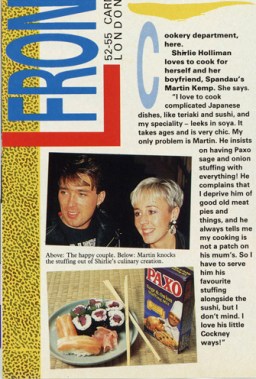
They interviewed Martin Kemp’s then-girlfriend (now wife) Shirlie Holliman about her love of cooking and her passion for ‘complicated Japanese dishes, like teriyaki and sushi.’ Holliman claimed her speciality was ‘leeks in soya. It takes ages and is very chic.’ Just Seventeen was very much a magazine for cool, cosmopolitan girls and Holliman’s “chic” interest in Japanese food certainly fits this image. The association of “foreign” food with “chicness” reveals a still problematic issue of the ways in which a predominantly white Western media appropriates the food and practices of other cultures, obscuring the traditions and meanings of, for example, dishes and clothing in the name of promoting a new trend. The Racist Sandwich is a great and informative podcast, which discusses the ways that media representations of consuming and cooking food are political, if you’re interested.
Shirlie Holliman’s interest in “trendy” Japanese food aside, she had another problem. Her boyfriend insisted ‘on having Paxo sage and onion stuffing with everything!’ Martin Kemp who complained that her cooking was ‘not a patch on his mum’s’ didn’t appreciate the effort Shirlie put into her “chic” cooking. Fortunately for Martin though, Shirlie was happy to appease him and rather than depriving him ‘of good old meat and pies and things’ she cooked him his stuffing alongside every meal. Here is a lovely photograph of a box of Paxo sage and onion stuffing next to a plate of sushi just in case you were struggling to imagine what that might have looked like. You’ll have to imagine what it looked like with cooked stuffing, not to mention how it tasted.

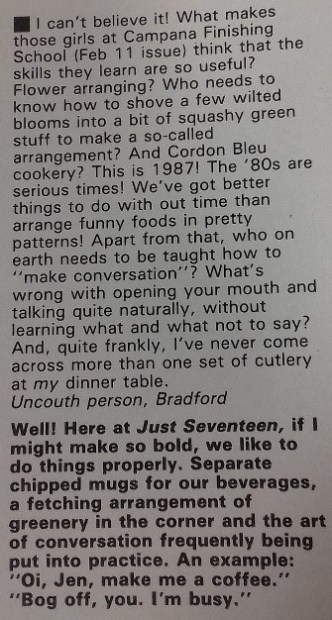
That it might be the result of a bizarre promotion deal with Paxo aside, it is interesting that this piece featured in Just Seventeen. Compared to its contemporary Jackie, which was fonder of publishing recipes and prompting more traditional domestic activity for girls, Just Seventeen appears at a glance to have been more anti-domestic. This reader letter from the March 4th 1987 issue sums up the tone of the magazine concerning domesticity quite well:
Clearly, the piece on Martin Kemp’s penchant for stuffing is meant to be funny, and the kind of “wacky” celebrity fact that features frequently in pop culture-centric magazines. However, its undertones of gendered domestic work are apparent through the language used to depict Shirlie’s “job” as home cook. Martin ‘insists’ on having stuffing with every meal and Shirlie says that he: ‘complains that I deprive him’ of cooking like his mum’s: ‘So I have to serve him his favourite stuffing alongside the sushi, but I don’t mind. I love his little Cockney ways!’ What is interesting about it is not what the actual divisions of labour might be in Martin and Shirlie’s relationship; in fact the next issue featured an interview with Kemp in which he revealed that he too liked cooking and ‘make[s] a good Indian. Is it difficult? Nah. You just open a tin and sling it in the pan. Har Har.’ (Again, refer to The Racist Sandwich!) And obviously his recent appearance on Celebrity Bake Off revealed both the strengths and weaknesses of his kitchen skills…
What I find interesting about this is the fact that it was published in Just Seventeen at all. As I mentioned earlier, it didn’t deal with traditional domestic femininity in the way that Jackie did. Angela McRobbie notes in her book Feminism and Youth Culture: From Jackie to Just Seventeen (1991) that in the 1970s romance was one of Jackie’s key themes (135). The magazine featured numerous stories about falling in love, alongside its promotion of traditional domesticity for girls through recipes, and knitting and sewing patterns, giving an overall feeling that the course of girls’ lives was set in relation to finding a husband and knowing how to be a wife when she did. In the 1980s, McRobbie argues, the influence of magazines like Smash Hits and Just Seventeen made the romances of Jackie less popular. With their glossy, information-heavy pages magazines like Just Seventeen shifted the focus from love stories to ‘an endless flow of information about the stars-about their lives, their future plans, their next record, their next tour’ (McRobbie, 1991, 144).
Placed amongst the ‘ecstasy of information’ (McRobbie, 1991, 144) that the layout of the magazine promised, it’s ‘garish multi-colour layout…[and] the use of different typefaces’ (McRobbie, 1991, 144), this piece is an interesting combination of the fast-paced facts about pop stars’ lives and a more traditional depiction of domestic arrangements. Looking at the two pages that this item was published on (below) we can get a sense of what McRobbie meant by an ‘ecstasy of information.’ These two pages have everything from AIDS, to Jonathan Ross, and Marks and Spencer’s new “airplant.” In Just Seventeen, it seems, there was space in a girl’s life for everything, all at once, and Martin Kemp’s eating habits were no exception.


By Katie Taylor.
-McRobbie, Angela. Feminism and Youth Culture: From Jackie to Just Seventeen. London: Macmillian, 1991.
 LJMU Special Collections & Archives