
I love a weekly plan. I have one on my wall, my phone, in my diary; I stick post-its on the walls, and scribble endless to-do lists on scraps of papers. This week I even made Rosie and I an Excel spreadsheet so we can organise our internship tasks and goals, colour coded and everything. So naturally I am fascinated by ways that the girls’ magazines that I have been reading encourage organisation in their teen readers. There’s nothing quite as boring as a spreadsheet printed between the pin-ups and horoscopes of course but laced throughout its pages Jackie magazine encourages various kinds of “order” from its readers, usually disguised as ways for young girls to express themselves, have fun with their friends, and bag themselves a boyfriend.

I’ve been thinking about a feature called Week Spot and how its humour and “silliness” works in conjunction with the domestic chores and tasks it encourages girls to fit into their week. A regular feature of 1970s Jackie, Week Spot was a day-by-day break down of tips, tasks, and zany suggestions for being ‘nice or silly or both’ every day. These usually featured on the first page of the magazine, in the top left hand corner, and so were likely to be the first thing a reader encountered when opening up to read.
Week Spot tasks might be to ‘Get up before the sun rises and wash your face in the May dew’ on a Saturday (01 May 1976) or ‘wear bracelets round your ankle’ on a Friday (08 May 1976). Perhaps even to ‘pretend to everyone that you’re a French girl’ on a Tuesday. The distinction between ‘silly’ and ‘nice’ things to do is sometimes obvious, and some of the suggestions are closer to jokes than things that the magazine might actually expect its readers to do (hopefully).
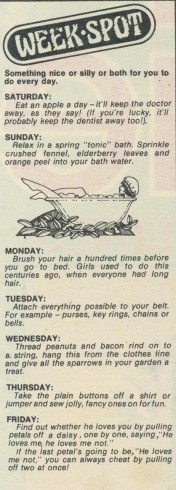
The suggestions seem to fall into the broad categories of dieting, family, domestic tasks, treating yourself (often beauty related), doing things for others (often domestic), and what I think I’ll simply call…miscellaneous.
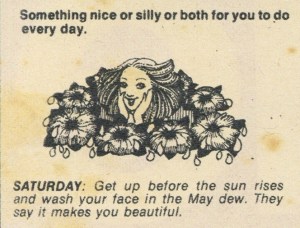
- Jackie. 01 May 1976. pg 2.
Often the ‘silly’ and ‘nice’ tasks alike involve domestic tasks like cooking, cleaning, home improvement and decoration. In an article in the 21st March 1987 issue Jackie looks back at its history in ‘Jackie: The Baby Pics!’ They printed the cover of the very first issue in 1964 and discussed magazine content in a selection of issues up to 1982. The article claims that ‘Jackie was the first magazine for gals who weren’t interested in recipes or household hints’ (pg 14), but read any of its issues at all and it’s not hard to see that isn’t true. Perhaps it was a magazine for ‘gals’ who weren’t only interested in domesticity. Certainly, the way that domesticity is depicted differs from women’s magazines like Good Housekeeping, but nevertheless Jackie, even right up to the late 1980s when such content had dropped off a little in its frequency, was publishing recipes, sewing, knitting and customizing patterns and tips, as well as a range of domestic-themed crafts.
In the spirit of a true Jackie girl, here’s a cut-and-paste digital collage (or as some call it a GIF) of Week Spot domestic tasks from the 1970s:
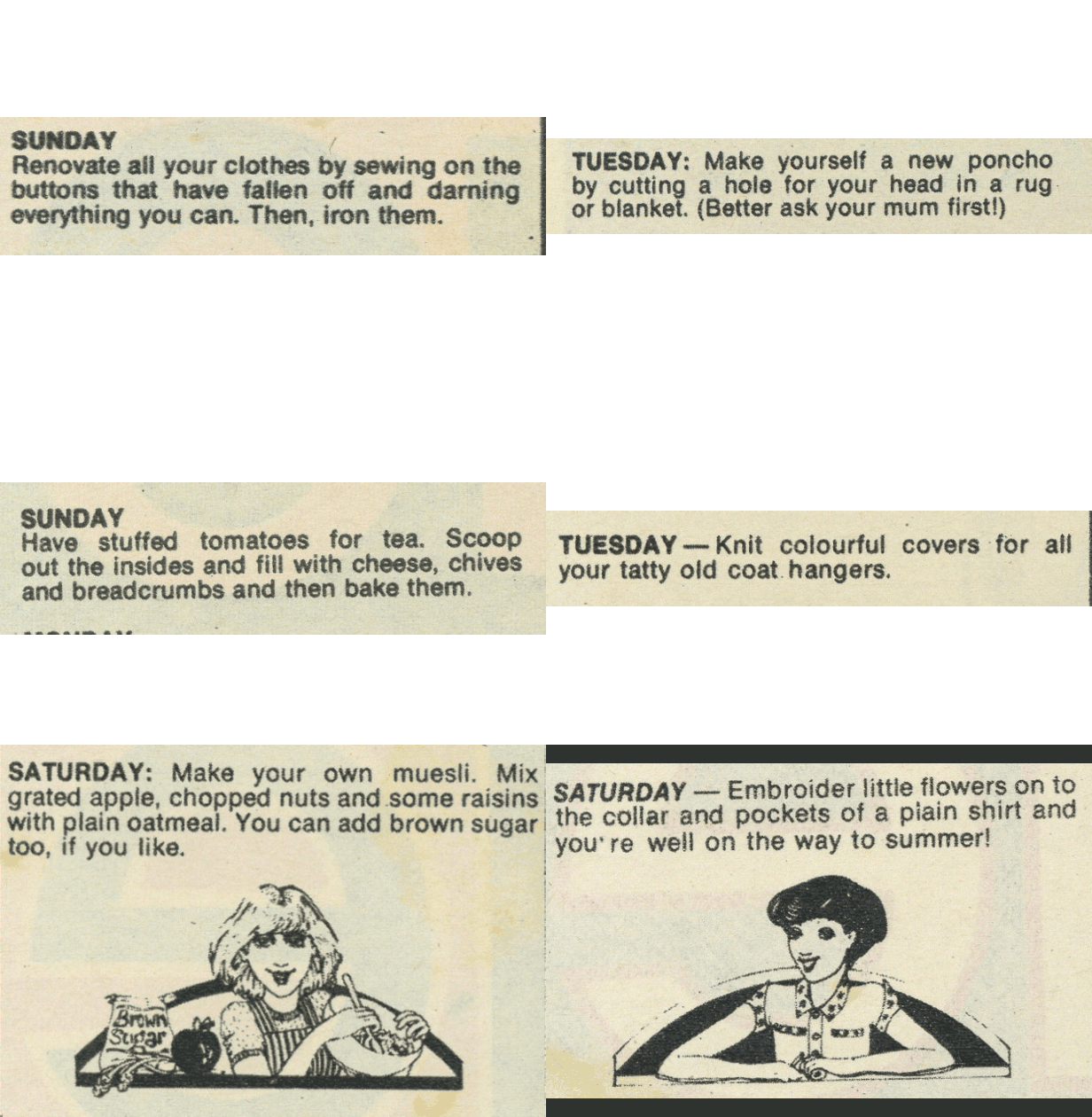
(I learned to make GIFs this week and I am very excited about it, but if you want to actually read these examples there’s an appendix at the bottom of this post!)
The eagle-eyed amongst you will have noticed that my GIF doesn’t include a traditionally ordered week. This is because I want to subvert the ideology of domestic organisation for girls and assert my agency over the magazine in creating my own media from its pages. Okay… it might have been accidental, but that’s a good point isn’t it? You can read more about creative agency and Jackie readers in Rosie’s last post on the blog.
Amongst the more prolific photo stories, short stories, fashion spreads, celebrity interviews, and pin-ups, the domestic features in Jackie do seem minimal, even marginal at times. It’s easy to understand why the magazine wanted to claim that it was not about these things, they weren’t exactly cool or on-brand for a teen magazine. Jackie might not have marketed itself as a domestic magazine, but interwoven in its pages were numerous tasks that incorporated traditional domesticity into its teen-centric content.
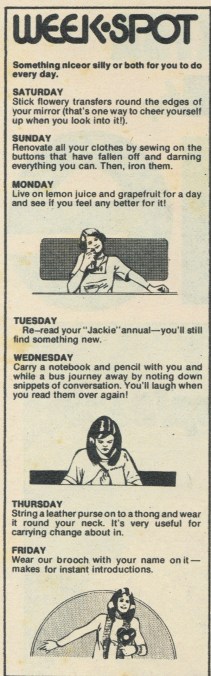
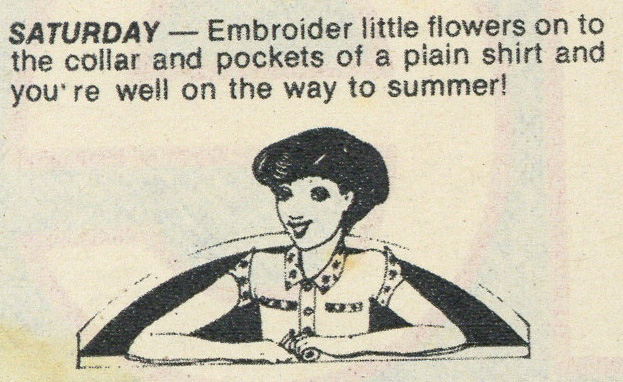
The Sunday suggestion in the March 6th 1976 Week Spot is to ‘renovate all your clothes by sewing on the buttons that have fallen off and darning everything you can. Then, iron them.’ This is one of the more sombre suggestions I’ve read. Jackie is packed full of tips on renovating and customizing old clothes but they are usually lighter in tone and presented as fun ways to make yourself stand out. The 8th May ’76 Week Spot for example suggests for Saturday that readers ‘Embroider little flowers onto the collar and pockets of a plain shirt and you’re well on your way to summer!’ This is a more typical example of the sewing-relating activities in the magazine, but I think the above example is interesting for its straightforward suggestion of domestic work. As I read through a number of issues I started to see that there were more examples like this. I had the impression that Jackie’s domestic content was largely presented as fun, usually consisting of fashion ideas and weird recipes. But suggestions like ‘Polish every possible surface in your bedroom’ (21 February 1976), and ‘Knit colourful covers for all your tatty old coat hangers’ (13 April 1976) are difficult to read as anything but straight up chores.
Week Spot seems to have dropped off as a feature in the 80s, but in the 70s it stands as a good example of how a magazine attempted to hide the more traditional aspects of its domestic content alongside fun tit-bits that seemed oppositional to the ‘fuddy-duddy’ magazines for women it claimed not to be.
By turning chores into a weekly plan of leisure and fun, Jackie could conceal the fact that even if it wasn’t meant to be a magazine for girls who were interested in recipes or household hints, it was a magazine that was finding ways to instil these practices in its young readers’ lives. Christine Griffin notes that the 1980s research discourse on youth and leisure found that the increasing amount of ‘life-skills’ literature and government-sponsored youth training programmes showed that: ‘individual young people must be taught how to use their leisure time in positive ways and how to curb their ‘rebellious impulses’ (1993, 138). Jackie might be seen as a 1970s example of a medium for encouraging young girls to be positive, productive members of society, with only the very mildest of rebellious streaks which, having been scheduled for Tuesdays, weren’t all that rebellious at all.


By Katie Taylor
Bibliography:
Griffin, Christine. Representations of Youth: The Study of Youth and Adolescence in Britain and America. Cambridge: Polity Press, 1993.
Appendix:


 LJMU Special Collections & Archives