
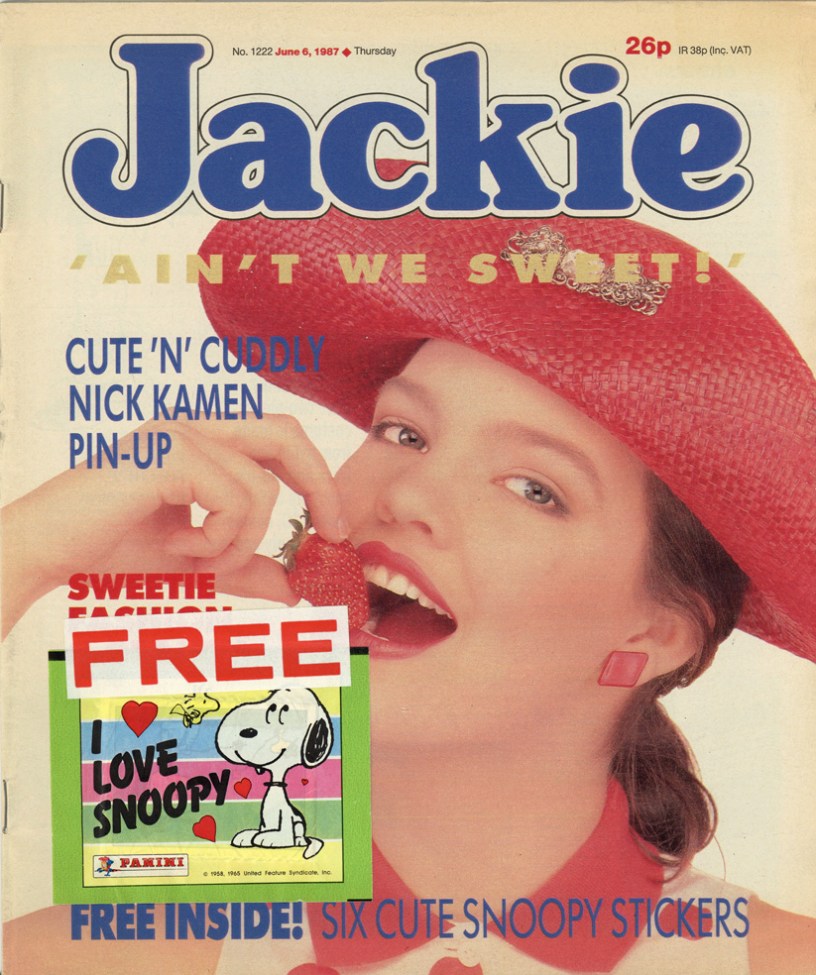
I tweeted this week about finding a copy of Jackie with the free gift (a packet of Snoopy stickers!) still attached to the cover, and MCC lecturer, and Femorabilia expert Nickianne Moody continued by tweeting a selection of other gifts she came across in 1929 issues of Woman’s Pictorial:
Throughout this internship I have been questioning how magazines cultivate a community of readers through their content, and how the identities of these readers are reflected and/or created, i.e. what sort of girls do magazines like Jackie and Just Seventeen “make” of their readers? So this week I started to think about how free gifts might contribute to the overall identity of a magazine and the way it creates an image of, and perhaps for, its readers.
Robin Parker (2007) writes about contemporary magazines and the ‘branded freebie’ noting that publishers cash in on promotion deals because magazines with free gifts can sell up to 30% more copies than those without branded promotions. The marketing and editorial teams of magazines design the promotions carefully, offering editorial coverage of the products as well as giving them away to ensure that they maximise co-branding opportunities. Chris Powell (2002) writes that these promotions are mostly about strengthening brands and increasing sales. Eric Fuller of the IPC publishing group is quoted as saying that ‘gifts that seamlessly reflect exactly what the brand is all about’ are valuable to both the magazine and the reader.
I am a glutton for a free gift myself (it works!) and I decided to do a little comparison between contemporary magazines and those in the collection. I bought Go Girl, and Shout and compared their free gifts to the things that Jackie and Just Seventeen gave away in the 80s.


Go Girl is aimed at young girls and issue 274 gives away a glitter tattoo set, a DC Super Hero Girl’s pencil-case set, and a packet of slime. Shout is aimed at slightly older teenage, or tween-age, girls and issue 580 gives away a set of celebrity and emoji style stickers, blusher, a hair scrunchie and a pair of sunglasses.
The nature of the gifts differs with the age groups represented by each magazine, from an emphasis on creative activity in Go Girl to beauty products in Shout. The free gifts perfectly reflect the intended readership and work alongside the magazine’s features. The creative gifts of Go Girl put an emphasis on fun that reflects the magazine’s brightly coloured and busy cover as well as its colouring-in and cartoon features. Shout’s gifts of beauty and fashion accessories reflect the magazine’s image of a “maturing” girl depicted in articles on self-confidence and dealing with periods.


The amount of free gifts and the obvious planning that went into the branding of these contemporary magazines is interesting in comparison to the selection of Jackie and Just Seventeen magazines I looked at.
I took a selection of Jackie from 1987 and of Just Seventeen from 1985 and 1986 and looked for covers offering free gifts (unfortunately there are no gifts left except for the Snoopy stickers).
![20180715_093804[1]](https://ljmuarchives.blog/wp-content/uploads/2018/07/20180715_0938041.gif?w=616)
Jackie’s gifts were: Snoopy Stickers, A Little Black Book of Hunks, A Crazee Comb, and Orbit Chewing Gum.
Just Seventeen’s gifts were: A Keyring, Earrings, Silrikin Hair Gel, An Address Book, A Zipper Bag, 6 Bangles.
With both magazines the cover model tends to be wearing or holding the gift that is on offer. In the contemporary magazines the gifts are “extras” that reflect the magazine’s brand but they don’t explicitly feature on the cover, where celebrities feature instead. Whilst Jackie and Just Seventeen did occasionally have celebrity covers (you might have spotted Patsy Kensit there), the covers mostly feature unnamed models, which contributed an “every girl” feeling to the magazines.
The promotional gifts with Jackie and Just Seventeen are demonstrated “in action,” and the cover girl gives a highly personalised feeling to the magazine; they say “this could be you!” However, it is interesting that the stuff on offer isn’t that different across the four magazines that I looked at; Jackie and Just Seventeen feature the same mixture of creative gifts like stickers and beauty and fashion items like hair gel and earrings as Go Girl and Shout. Perhaps the popular girls’ magazine image of what a girl “is” hasn’t changed all that much over the years.
I think I expected to find a bigger difference between the free gifts of the 80s and contemporary magazines, and I thought I would be writing about the different ways these magazines “branded” girlhood. However, the difference is not in what was given away, I don’t even think I’d bat an eyelid if I saw a magazine in the newsagent’s was giving away those multi-coloured bangles, in fact I’d probably buy them, I used to love them (we called them shag-bands in the 90s for some reason, but if there was a name like this for them in the 80s too there’s no way Jackie would have published it).
What has struck me though is the how prolific branded promotions are now, especially via children’s media. Free gifts with magazines, despite the purely economic desires of publishers and brands who profit massively from these deals, often look quite innocent, fun even. But it’s via more prominent platforms like YouTube that the conflation of consumption and childhood starts to look more sinister.
I think it’s safe to say that more children in the UK and US probably watch YouTube more often than they read magazines now, and as a platform, YouTube takes branded promotions to a whole new level. The biggest YouTube channels, and we are talking those with millions and millions of subscribers and views, are usually heavily involved in branding deals and regularly promote products to their viewers. The unboxing of products is even its own genre of YouTube video, most strikingly with child YouTubers.
There are countless examples of this kind of video, this example comes from a popular channel of family video-gamers with 7,170,974 subscribers (at time of writing). But search any channel or video aimed at children and young adults whether its theme is gaming, vlogging, beauty, crafting, comedy, whatever, and it’s clear that product promotion is prolific via this medium.
In these cases, the products on display are not free to the viewer, the video itself is the product, but just like the gifts that come with magazines these branded promotions contribute to the image and practice of children as avid consumers.
By Katie Taylor.
Bibliography
Parker, Robin. ‘The Rise of the Branded Freebie.’ Promotions & Incentives; London. (Jun 2007): 23-24.
Powell, Chris. ‘Freebies for the fickle reader: magazines are giving free gifts such as CDs and daybooks in an attempt to lure new subscribers.’ Marketing Magazine; Toronto. Vol. 107, Iss. 38, (Sep 23, 2002): 19.
 LJMU Special Collections & Archives
This is an excellent piece – as they all are – perceptive and thoughtful. Keep up the good work.
LikeLike
Thanks very much! -Katie
LikeLike