
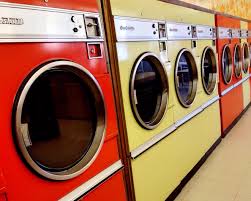
In order to set the scene for this post I think we should all take a moment to watch this Levi’s advert from 1985, purely for historical context you understand.
Like a good literature student, I have been hoarding my favourite stories from Just Seventeen and Jackie as I’ve been reading through the Femorabilia collection and this

week I am going to discuss two of them, both titled ‘My Beautiful Launderette’. Jackie and Just Seventeen published a story each by this title in 1987 in which young couples meet in, you guessed it, a launderette. These were no doubt inspired by the Nick Kamen frenzy that followed his rise to fame post-Levi’s advert.
The title might have come from Hanif Kureishi’s 1985 film in which a young British Pakistani man takes over his uncle’s launderette and restores it with the help of his former lover, the punk-racist played by Daniel Day Lewis. In a 2016 Express article Sadie Nicholas wrote that Kureishi’s film ‘explored racism and sexuality during the Thatcher era, much of it set in the very ordinary surroundings of a south London launderette.’
I studied this film during my undergraduate degree on a module about postcolonial literature, so when I came across the stories in Just Seventeen and Jackie by the same title, my immediate thought was: ‘A gay love story in a teenage girls’ magazine that deals with racism in Britain? Great!’ But, as I’m sure you can guess, these stories are more easily connected with Nick Kamen’s steamy Levi’s ad than they are with Kureishi’s brilliant film (you can watch it in a bunch of places online).
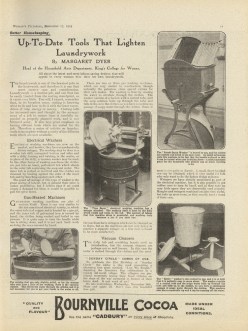
That’s not to say that I was disappointed by what I found, and I have also learnt a bit about the history of launderettes this week! The first launderette is thought to have been installed in Fort Worth, Texas, in April 1934 by the entrepreneur JF Cantrell, who bought four washing machines and charged people by the hour to use them. The electric washing machine was invented in 1908 but most families couldn’t afford their own, making Cantrell’s business move rather smart and profitable. Interestingly one of our supervisors found an article (pictured below) in a 1923 issue of Woman’s Pictorial recently on the latest gas and electric washing machines that look perfectly safe to use…
The first launderette in Britain opened in 1949 in Bayswater, London and by the early 1980s UK launderette numbers peaked at about 12, 500 (Andy Jackson, 2018). So Kureshi’s film and Kamen’s Levi’s ad, as well as London’s most famous EastEnd launderette all appeared in 1985 when the business was at its peak.
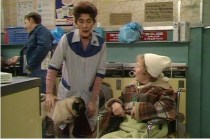
Two years later the launderette was clearly still riding its high as a popular romantic destination, and Jackie and Just Seventeen weren’t ones to take their fingers off the pulse. Elaine Kirkham wrote a story for Jackie’s April 25th 1987 issue told from the perspective of a boy who is forced to go to the launderette for his mum when their own machine breaks. To begin with he isn’t happy about it: ‘they’re unhealthy places these laundrettes. We might catch something.’
He hopes not to be recognised by anyone he knows as he slinks into the launderette, but then Karen Adams comes in. She is ‘one of those females who plagues the life of us ordinary guys…She is intelligent, very beautiful and super-cool.’ She’s a science whizz, planning on going to university and he is to be ‘a lowly P.E teacher’ so he doesn’t fancy his chances. But when Karen messes up her parents’ laundry, having washed whites with a red jumper (what a fool) he spots his chance.
Karen is distressed, it’s the first time her parents have left her alone and as well as the laundry disaster the house is a mess and she has forgotten to do the shopping. The gallant protagonist jumps in to help Karen: ‘You’re not very domesticated, are you?’ he asks her before telling her what to buy to soak the stains out, and offering to help with the shopping and tidying up the house.
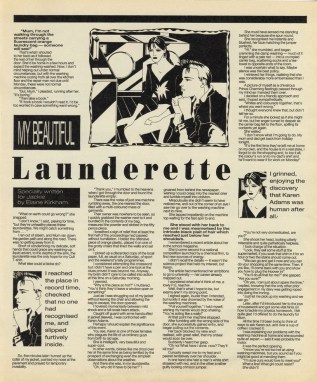
From an unwanted trip to the launderette this boy has helped a damsel in distress, shown off his domestic skills and set a date for the most beautiful girl in school to come round to his house…to fix his washing machine! The role reversal in this story is interesting, he has domestic skills but lacks academic intelligence (that’s the story not my own opinion of P.E teachers by the way) and Karen is hopeless in the home but a brilliant engineer and scientist. The “Nick Kamen Effect” in this story might have appealed to girls who were hoping that a handsome man could be found doing his own laundry (and be persuaded to do hers too). And perhaps the fantasy extended to boys too. Not being the stud, the boy in this story, the ‘ordinary guy,’ isn’t barred from romance in the launderette; he uses the skills he has to bag himself the girl.
In Ro Newton’s ‘My Beautiful Launderette’ in the March 25th 1987 issue of Just Seventeen the “Nick Kamen fantasy” takes a different form. He’s even explicitly mentioned in the story’s opening as the protagonist, Jane, tries to wake herself from her dreams of dancing with Nick in order to get to the launderette ‘in search of a real-life version.’ Jane, a scatty dreamer who stays up too late reading Mills and Boon novels, rushes out to the launderette without makeup on, wearing the remaining tattered clean clothes that she has. It doesn’t matter how she looks because Jane knows she’ll only meet housewives there…
She sets herself up with ‘her latest soppy novel’ and is interrupted when a handsome, fair-haired boy tells her that her wash is finished. They start chatting and flirting and he says ‘Launderette’s are fascinating places, don’t you think?…They can really affect your mood…I’ve become quite an authority on launderettes, you know. I’m thinking of writing a book on them one of these days.’ Jane is fascinated by this smart, notebook-carrying sociological genius but is disappointed when after he walks her home, he doesn’t ask her out. Luckily, he snuck a note into her washing asking her to the disco and Jane dances the night away with ‘a man who looked nothing like Nick Kamen. She was glad. Glad she’d spent her Saturday morning in her beautiful launderette. And glad she wasn’t dreaming this time.’
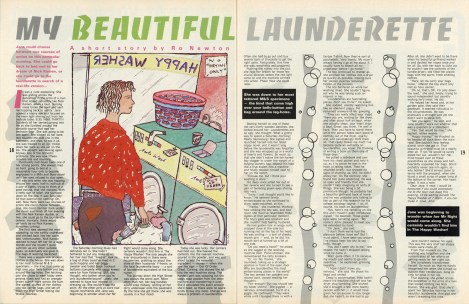
Jane passes up her fantasies for the real deal, a real boy who she is glad doesn’t look like Kamen. In displacing the characters’ fantasy for reality, the story provides another fantasy for the reader. The launderette is a real place where real people go to sort out their washing. But even real, ordinary people can find romance amongst the bubbles. These stories offer different spins on the launderette romance; for the girls who know there are no Nick Kamen’s but are happy with what is there instead, and for the boys are no Nick Kamen’s themselves but get the girl anyway.
The launderette might not be the staple it once was, with only about 3000 left in the UK, but some experts believe that our need to wash our duvets might sustain them a little longer (Andy Jackson, 2018). Nevertheless, the launderette romance remains a familiar staple in popular culture, I’ll finish with a few examples but feel free to send me anymore you know of! I think I have come to agree with John, the boy in Newton’s story; launderettes are indeed, fascinating places!
By Katie Taylor
Bibliography
Jackson, Andy. ‘May 9, 1949: Britain’s first launderette sets a revolution in motion.’ Bt.com. 8 May 2018.
Nicholas, Sadie. ‘Is this the end of the launderette? A brief look at its history.’ Express.co.uk 7 March 2016.
 LJMU Special Collections & Archives
