
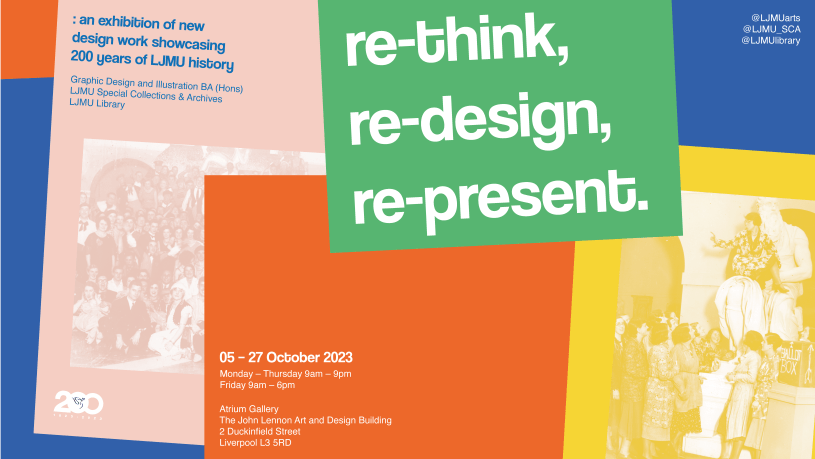
LJMU Special Collections & Archives launches a new exhibition curated in collaboration with the School of Art and Design. Fourteen first year Graphic Design and Illustration students explored our institutional archives to create new artwork inspired by students and educational pioneers of the past. Their art commemorates 200 years of University history, beginning with the opening of the Liverpool Mechanics’ and Apprentices’ Library in 1823.

The exhibition runs 05 Oct – 27 Oct in the John Lennon Art and Design Building, 2 Duckinfield Street, L3 5RD.
Opening times:
Mon-Thu: 9am-9pm
Fri: 9am-6pm
Student designers Abi Exon, Alice Muirhead, Charlotte Wood, Cora O’Gorman, Daniel Griffith, Ethan McQuirk, Hannah Jones, Holly Banks, Jessica Phillips, Joseph McDonough, Matt Burke, Mike Fearon, Millie Hynes, and Vivianna Caldeira brought characters and culture to life through their re-interpretations of Liverpool’s educational history to tell new stories about the archive, displayed alongside some items from our collections.
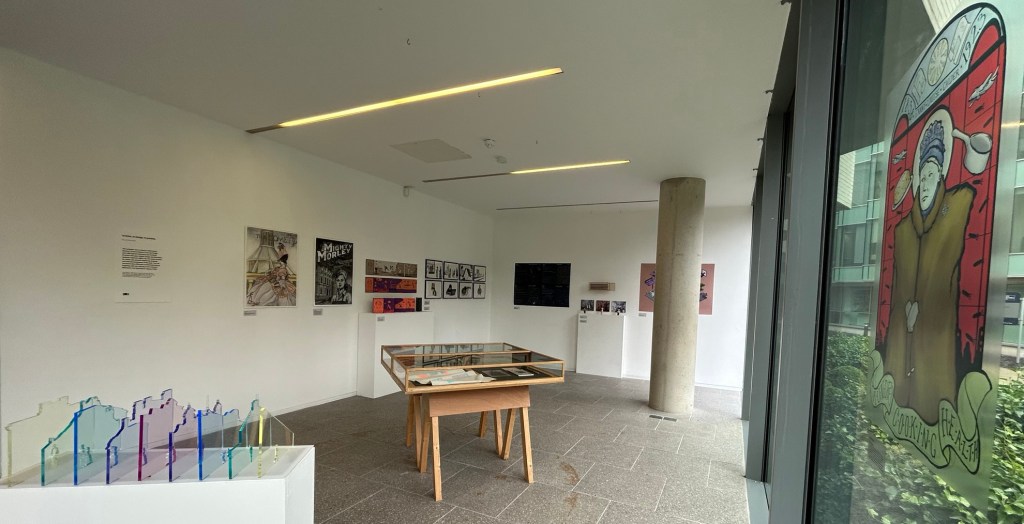
Featured Artwork
The exhibition is best viewed in person, but in case you aren’t able to be here, here’s a rundown on what you’re missing:
Alice Muirhead: LJMU in Reflection
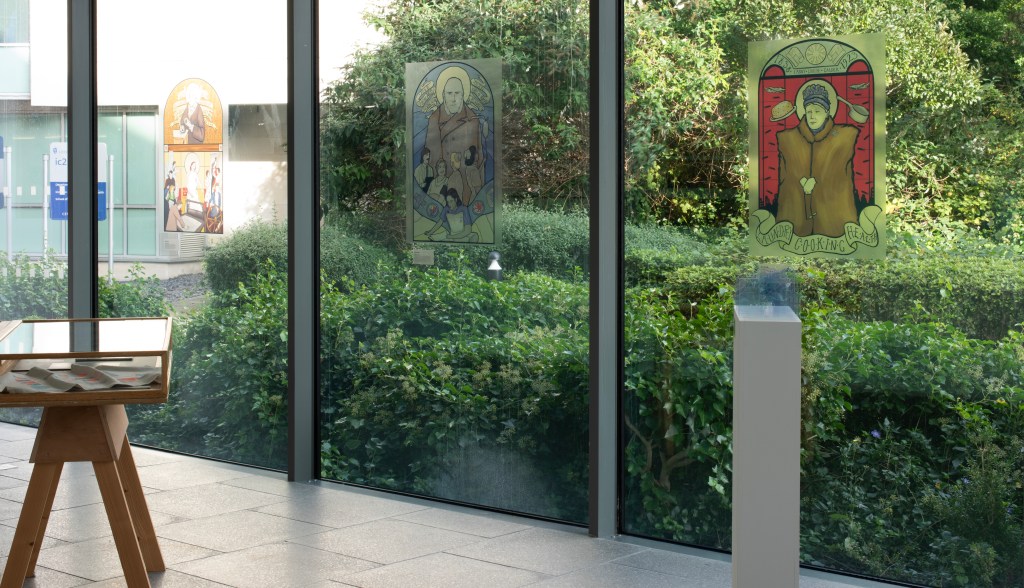
Lining the windows of the atrium gallery is Alice Muirhead’s LJMU in Reflection. These illustrations celebrate two centuries of contributions from educational pioneers and historic students across the fields of arts, health, domestic craft, sports, science, and technology. They include: William Roscoe (1753-1831), proprietor of the 1825 Liverpool Mechanics’ Institute, which led to the 1832 Liverpool School of Art; William Rathbone (1819-1902), co-establisher with Florence Nightingale (1820-1910) of the 1862 Liverpool Nurses’ Training School which LJMU’s School of Nursing and Allied Health descends from; Fanny Louisa Calder (1838-1923), founder of the Liverpool School of Cookery, later F L Calder College of Domestic Science; Irene Mabel Marsh (1875-1938), founder of the 1900 I M Marsh College of Physical Education for women; and Sir John Moores (1896-1993), the successful businessman and founder of Littlewoods whom the 1992 Liverpool John Moores University is named after, ‘in the spirit of optimism.’
The stained glass style was inspired by an 1892 letter from Florence Nightingale to Fanny Calder, describing her as ‘Saint of the Laundry, Cooking, & Health!’ This letter can be viewed in the archive in person or online using the reference number LJMUH/FLC/13/1/1.
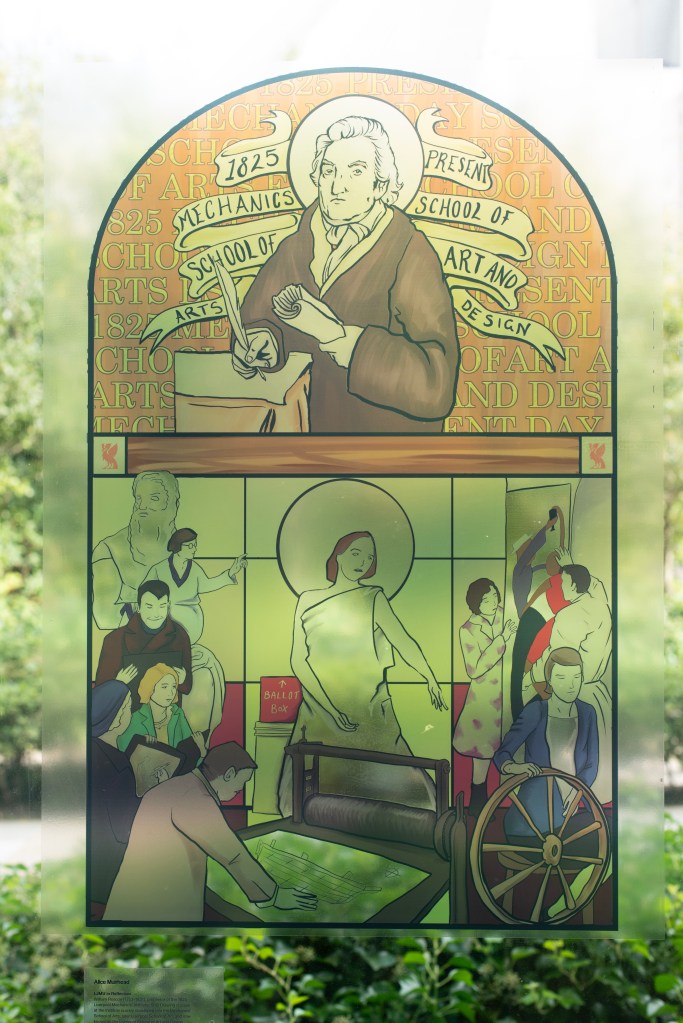

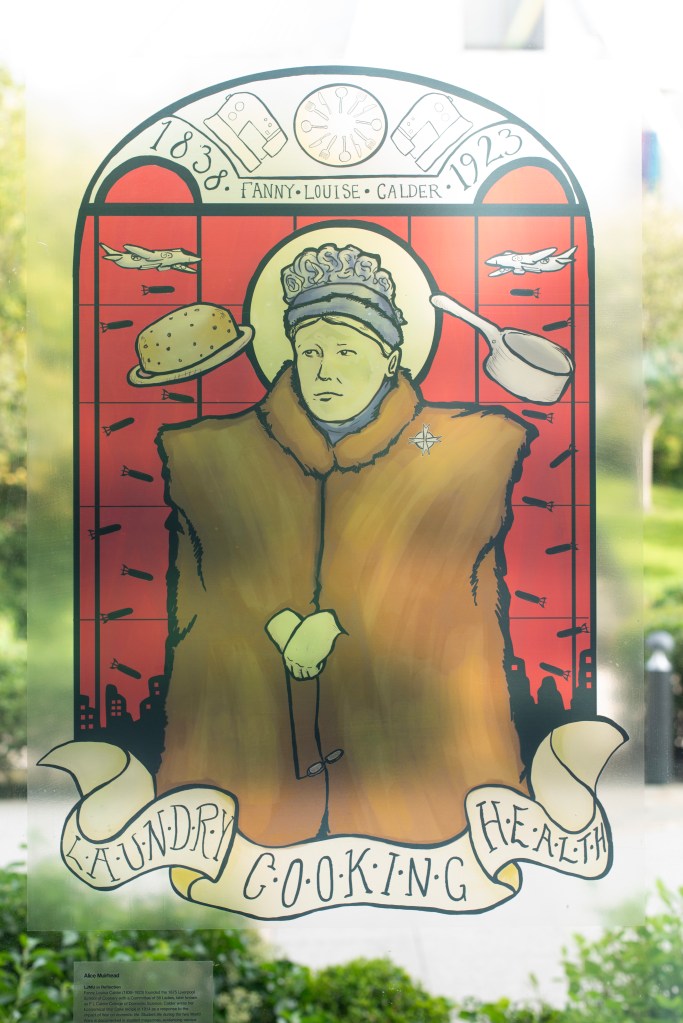
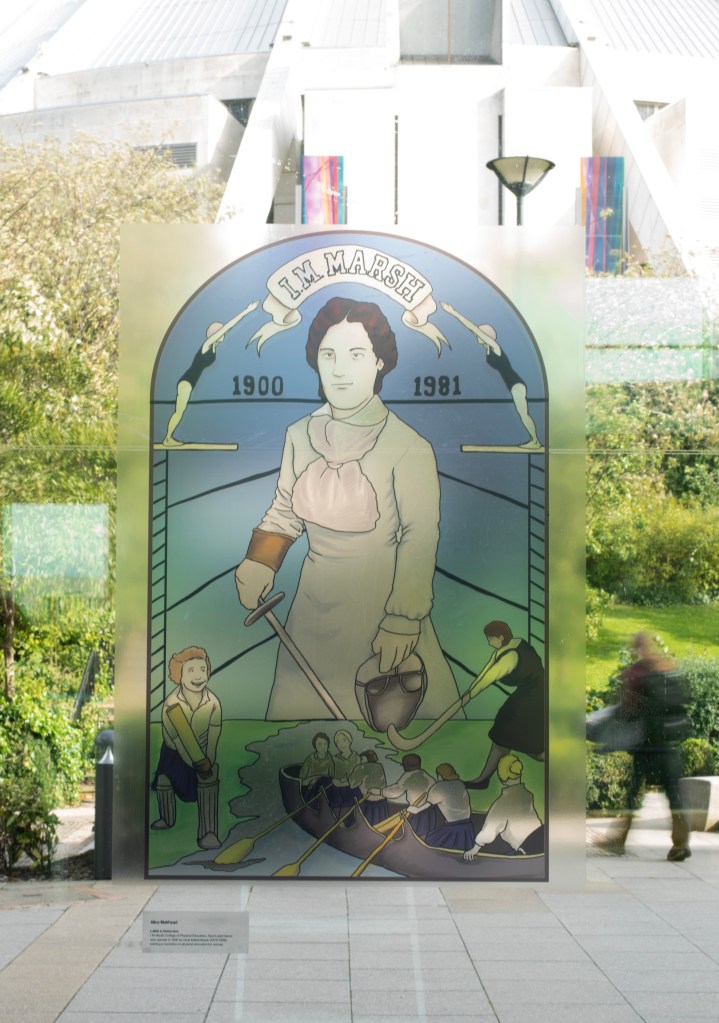
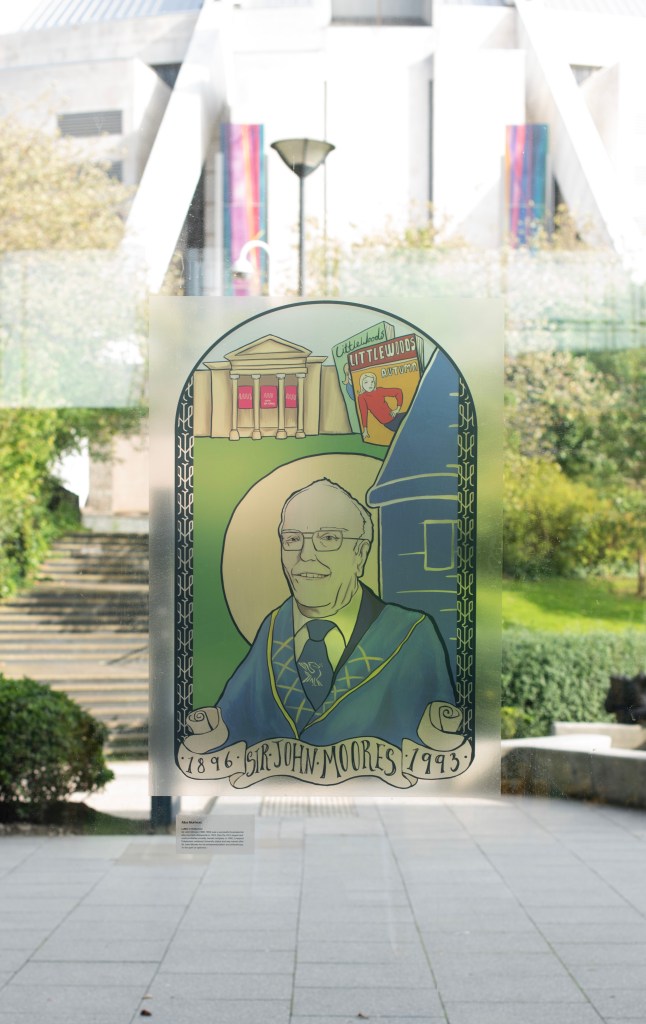
For more information on the individuals featured, as well as the archival images of students used as inspiration within Muirhead’s design work, visit the exhibition in person or contact LJMU Special Collections & Archives.
Hannah Jones: Modern Day War Cake Recipe
Hannah Jones’ Modern Day War Cake Recipe illustrates the Economical War Cake Recipe written by Fanny L Calder, founder of the 1875 School of Cookery, at the onset of War in 1914. The original recipe suggested dripping as a cheap fat alternative, which this version has replaced with butter for a modern audience.
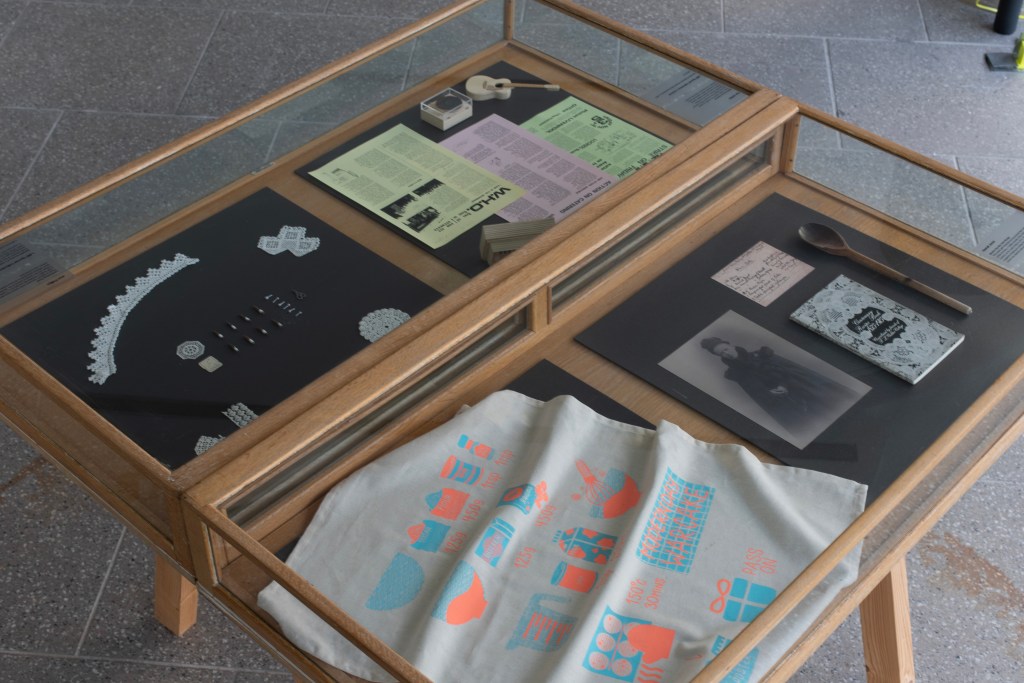
Her design was featured alongside an image of Fanny Louisa Calder, an archival reproduction of Calder’s original recipe written 29 May 1914, and a copy of the Centenary Recipe Book 1975-1975 compiled by Margaret Hall in 1976 with contributions by past and current staff and students. This archival material can be viewed in person at the archive or online using the catalogue via the links above.
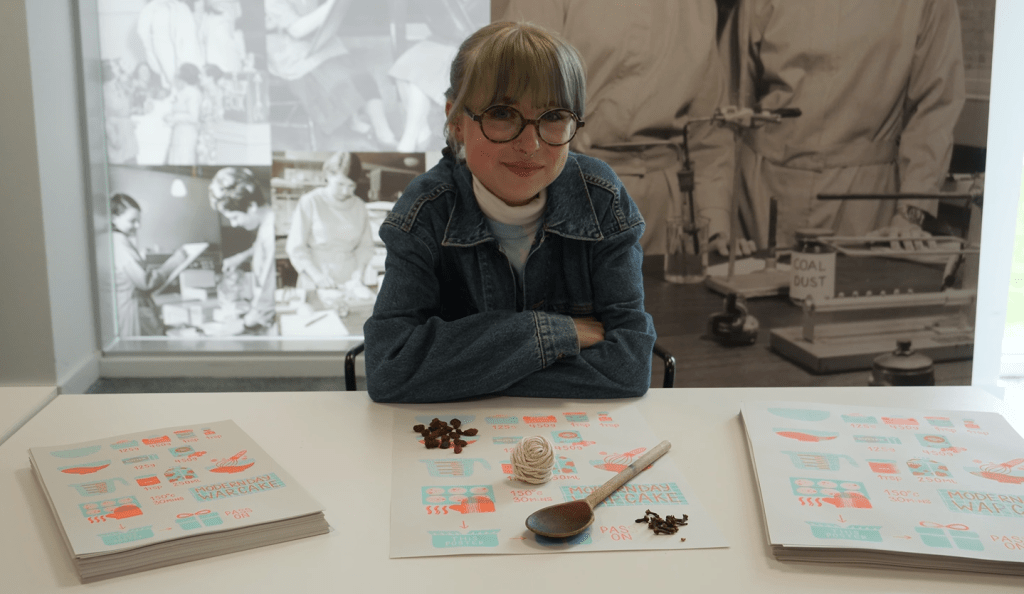
Jones’ design was risograph printed onto both cotton canvas as a tea towel for display in the exhibition, and also onto paper as a poster design in A4 and A3. Copies of the poster are available for free at the exhibition.
Daniel Griffith: Walton House Artefacts
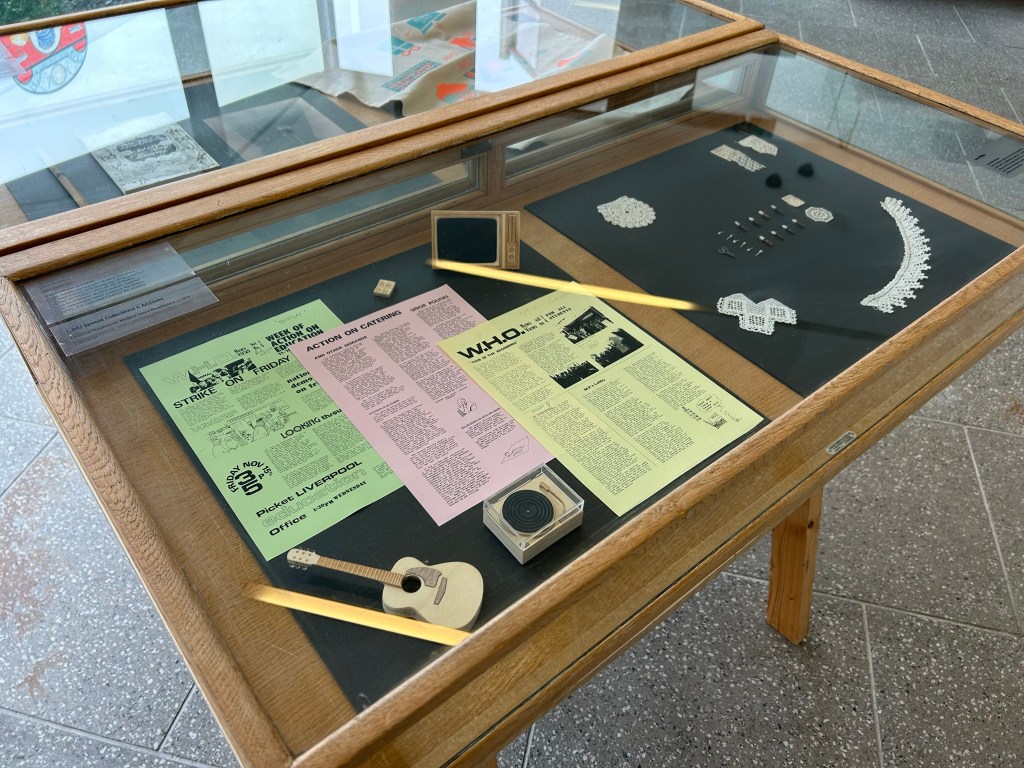
Daniel Griffith’s models explore how student occupiers may have passed time during the 1970s Liverpool Polytechnic Student Union sit-ins at Walton House for improved student welfare. His artefacts are displayed alongside some archival reproductions of the SU newssheets which inspired him, which evidence the tactics, activities, and motivations behind the protests. In the background of the exhibition is a soundscape produced by Griffith to reflect the atmosphere of the sit-in protests.
Jess Phillips: Lacemaking Tools
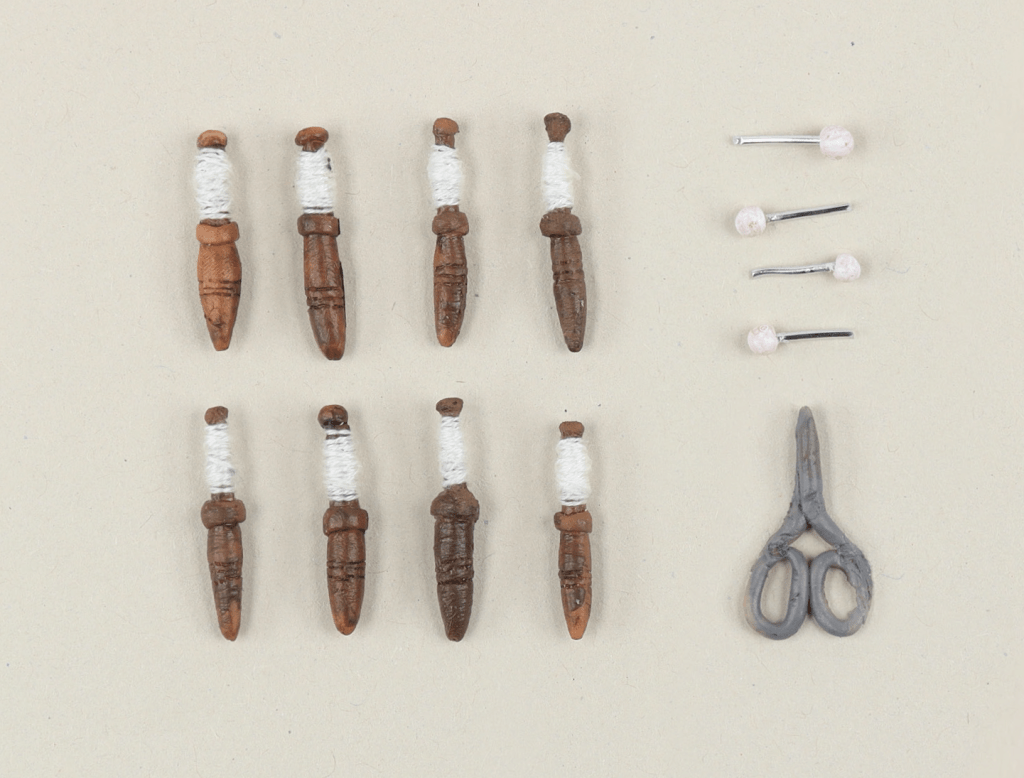
Jess Phillips’ miniature sculptures represent tools used in lacemaking, a skill taught in Needlecraft courses at both F L Calder College of Domestic Science and the Liverpool School of Art. Students learnt different techniques to produce bobbin, needle, knitted, and crochet lace.
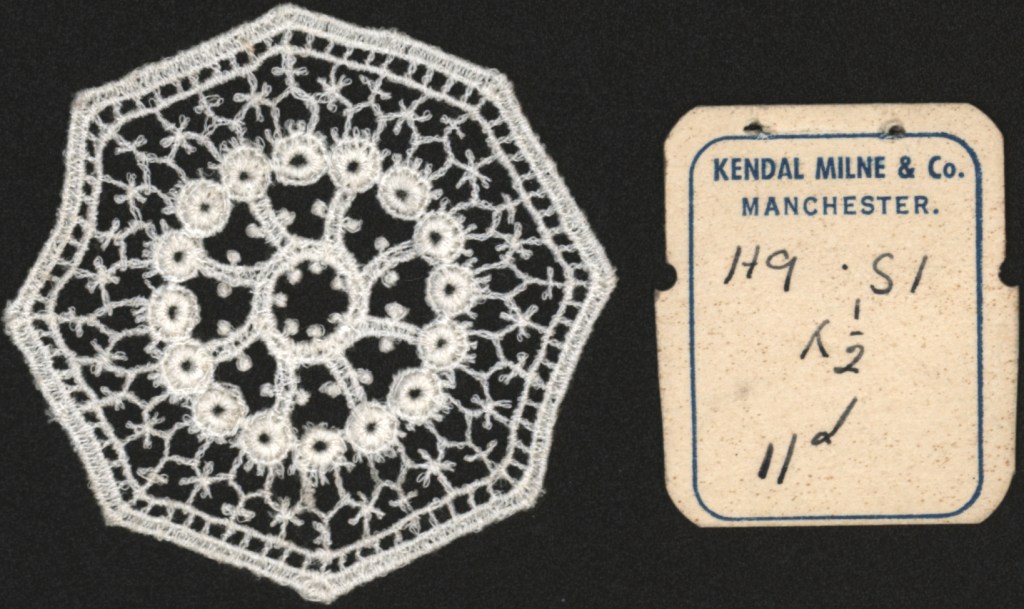
Displayed alongside the miniature tools is some original samples of lace from the archival papers of F L Calder College. Most of these samples lack provenance, but were likely produced in the late 19th Century until the early and mid 20th Century. Some may have been created by students or staff, and others purchased from lacemakers to demonstrate techniques to students. These and more textiles and garments can be viewed in the archive using the references LJMUH/9/33-34; 43.
Cora O’Gorman: The Comet
Cora O’Gorman’s illustration reinterprets the student magazine The Comet, originally published by Liverpool School of Art students 1910-1913, to combine Liverpool’s past with its present. Her re-inspired cover features the Liverpool Metropolitan Cathedral, which is visible from the John Lennon Art and Design building where the exhibition is held.

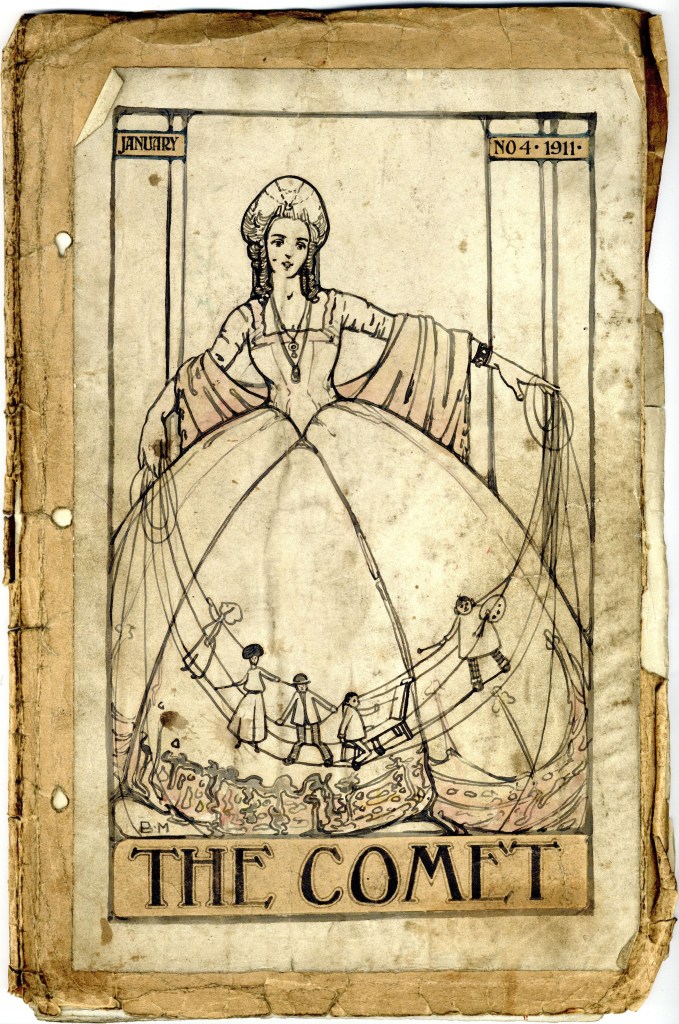
Although only her cover artwork features within the exhibition, O’Gorman’s full zine has been reproduced within stargazer Issue 1, 2023. stargazer is a new student publication produced by the LJMU Creative Writing Society and edited by Emmy Hallahan, and has a coincidentally similar astrological-inspired name. A copy of the limited edition stargazer publication is available to view at LJMU Special Collections & Archives, alongside the original 1910-1913 The Comet editions.
Mike Fearon: The Mighty Miss Morley
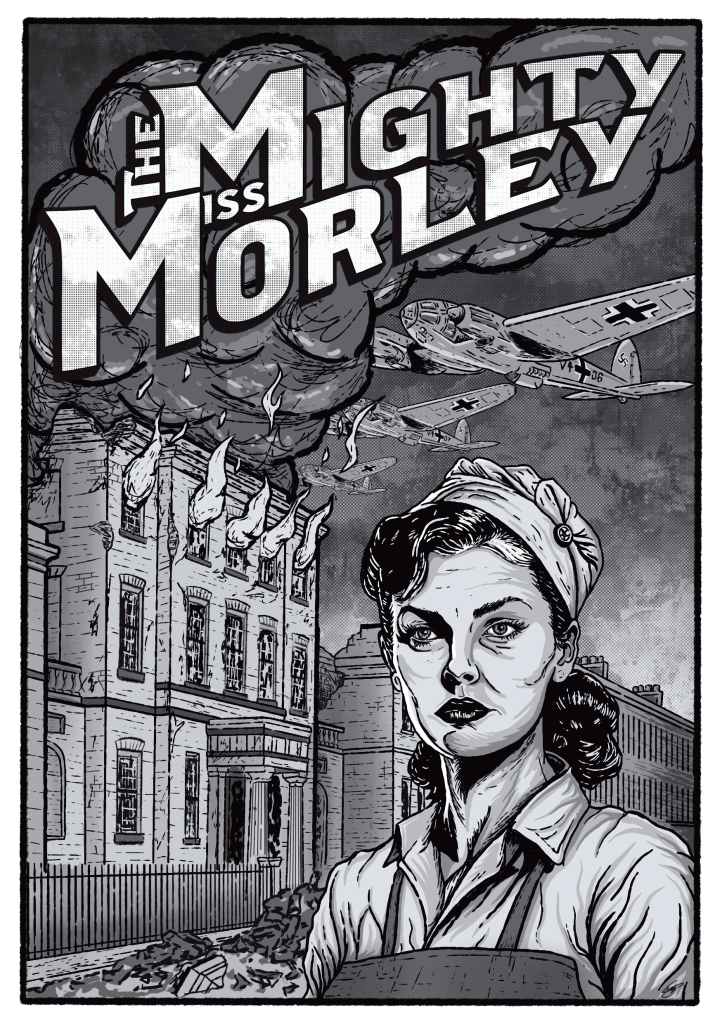
The Mighty Miss Morley is a short comic inspired by action taken on 5 May 1941 by Miss M M P Morley, Vice Principal of F L Calder College of Domestic Science 1939-1956. After a night of heavy enemy bombing, she directed the salvage operation by students to rescue upholstery and dresses for their final display from the burning College building on Colquitt Street, against the advice of authorities. Destruction of College premises during the Blitz led students to work from home until they could be relocated to Myrtle Street.
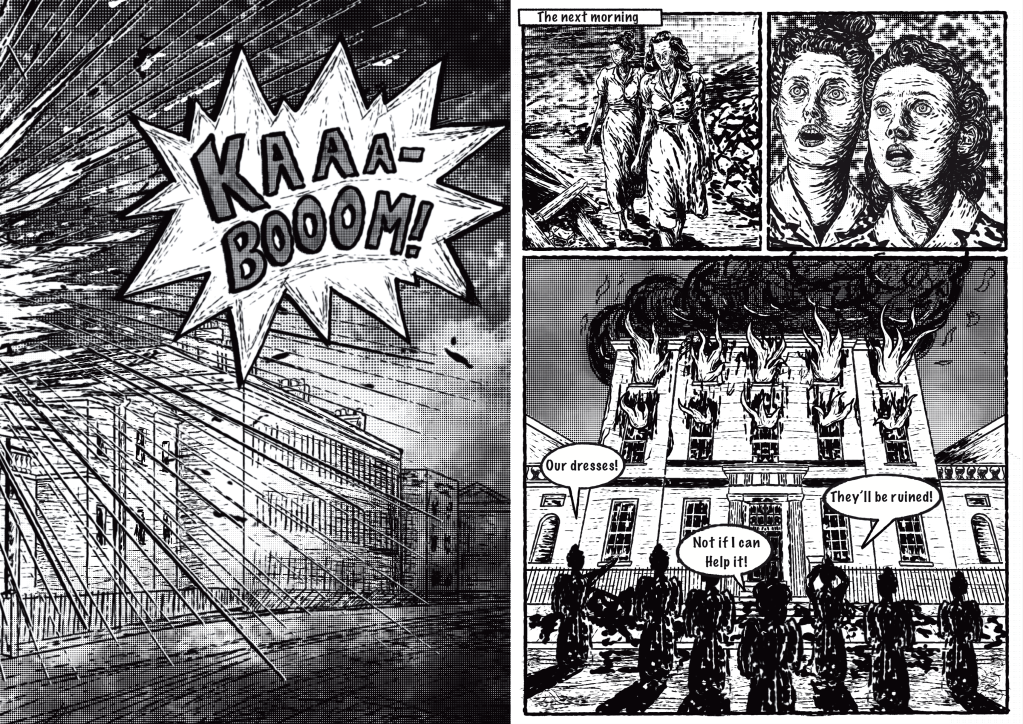
A full account of the night’s events which inspired Fearon’s comic is available within The History of F L Calder College of Domestic Science: 1875-1965 by Margaret E Scott (1967). Student life during the two World Wars is also well documented within the Old Student Society magazines LJMUH/FLC/5/1/2/1/1-2; 7-13 which discuss in detail: the contributions of staff, students, and alumni to service at home and abroad during the First and Second World Wars; the impact of rationing on domesticity; studying from home after the bombing of the Colquitt Street campus; and the loss of a fellow students’ life due to enemy bombing. These are all available to view in person at the archive, with some available online via the catalogue.
Ethan McQuirk: The Rules and Regulations of The I M Marsh College of Physical Education
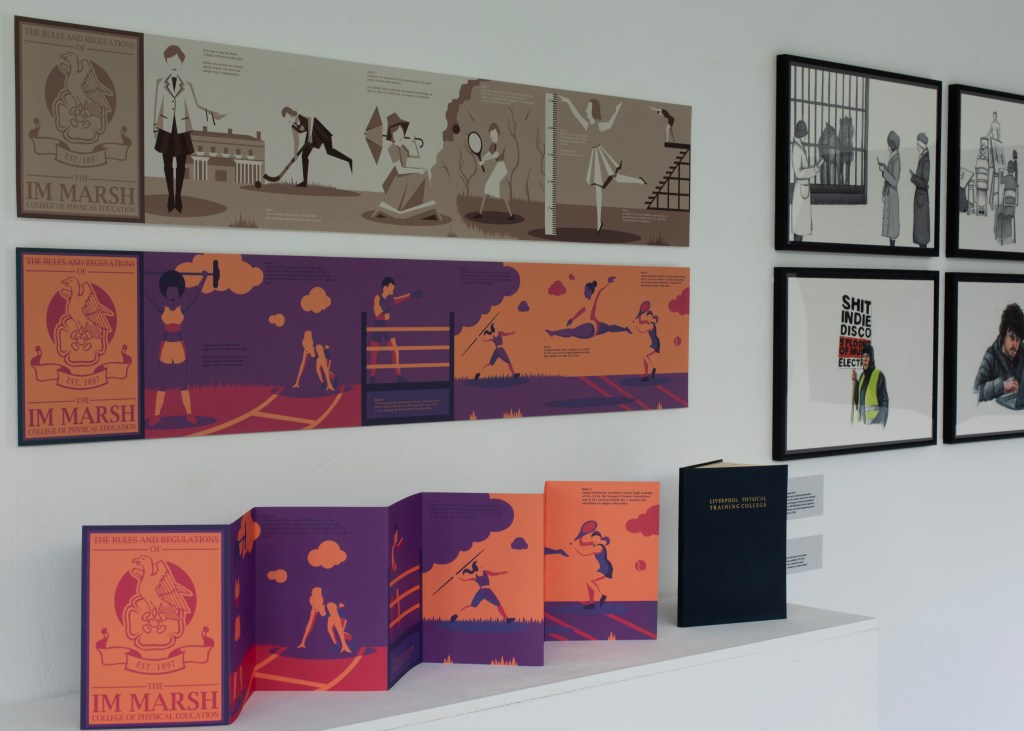
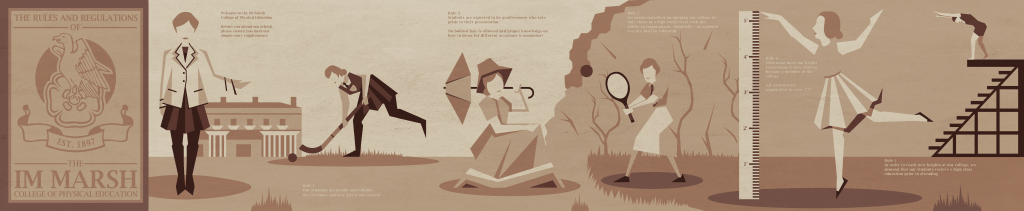
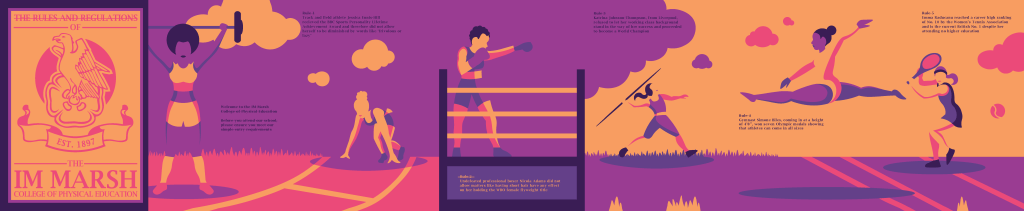
The Rules and Regulations of The I M Marsh College of Physical Education satirises the contrast in attitudes towards women in sport between the early years of I M Marsh College, and in how women are represented within sport internationally in 2023.
Established in 1897 and opened in 1900, I M Marsh College of Physical Education was a pioneering space to enhance women’s skills in sports education. Despite this, the early institution enforced misogynistic and classist ideals for student appearance, background, and behaviour. This included strict rules against bobbed hair and other fashionable styles in the 1920s; the necessity to be over 5’3″; to be of a good social position; have no regional accent; and be educated at a high class school. Evidence of these rules and their impact on students can be found throughout the I M Marsh archival papers, which are in the process of being catalogued for improved access. McQuirk’s booklet is displayed alongside a browsing copy of Liverpool Physical Training College, a history of I M Marsh College by May Hilton Royle (c.1960s), which is also available to view within the archive.
Matt Burke: Student Life
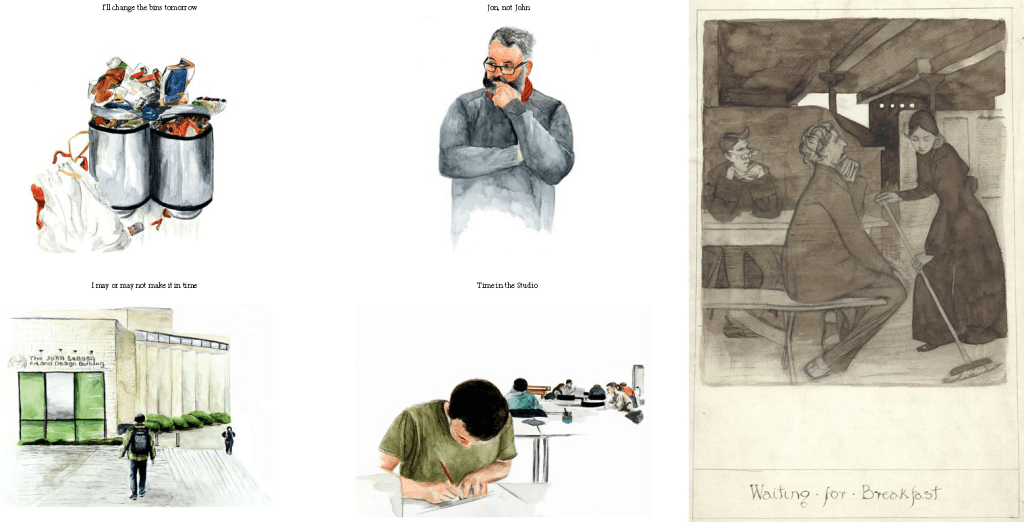
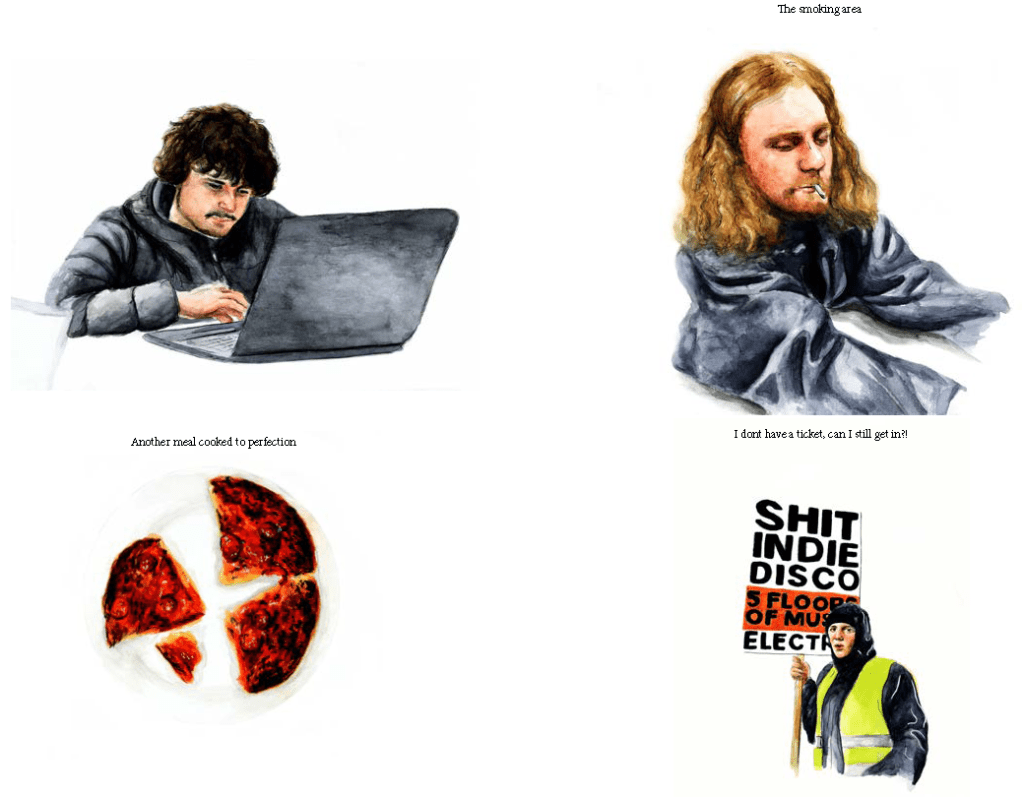
Inspired by artwork in the Liverpool School of Art student magazine The Comet, published 1910-1913, Burke’s watercolour illustrations capture the same day-to-day life of a student in a modern context.
Millie Hynes: Women in the School of Art

Hynes’ work celebrates early educational opportunities afforded to women at the Liverpool School of Art. Although the artwork takes direct inspiration from photography of women in the School of Art in the 1920s-1930s, the history of women in the School traces back to a hundred years prior.
Women were permitted to visit the Library and attend any lectures for 1 shilling as early as 1832 after the School’s split from the Mechanics’ Institute Mechanics’ School of Art (established 1825), although they were not permitted to attend classes of instruction until the 1850s. In 1857 Emma Gammage was the only female student registered at the School, and she became the first Liverpool Art Pupil Teacher in 1858.
These records, and more photographs of students at the School of Art, are available to view within the archive and will shortly be available via the online catalogue.

Joseph McDonough: Everton in the Community
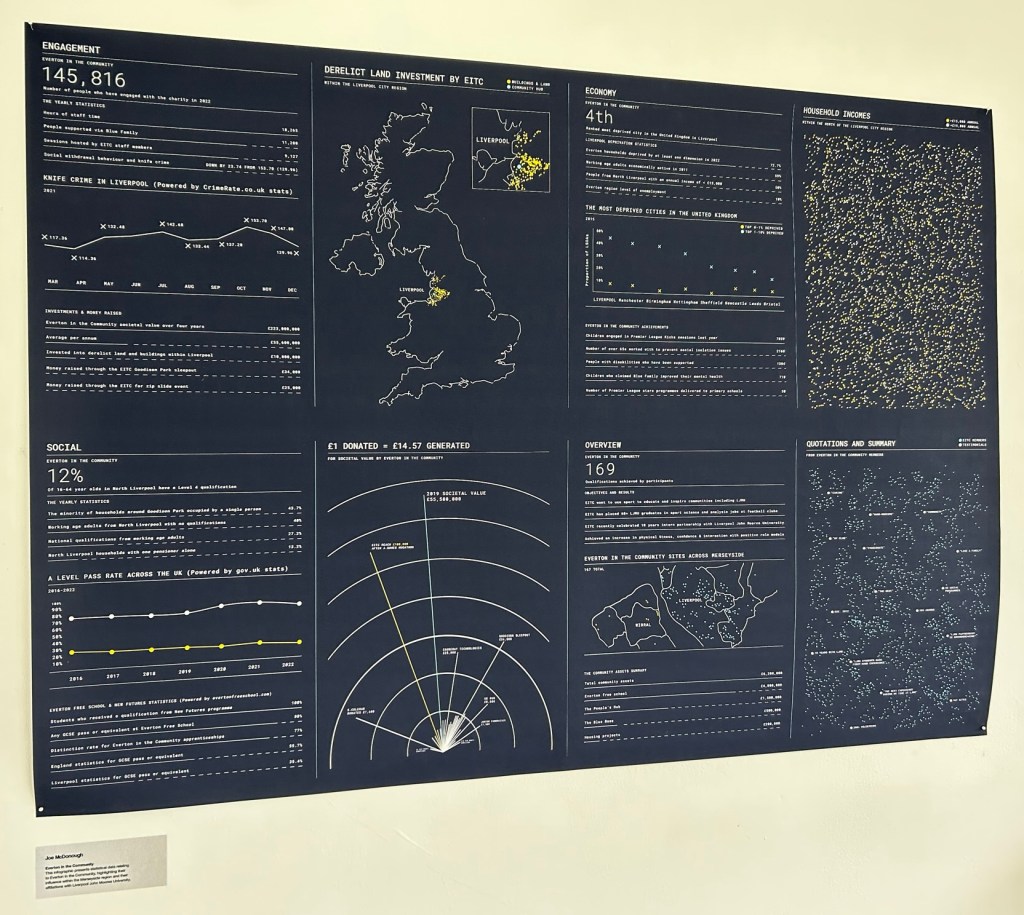
Joseph McDonough’s infographic presents statistical data relating to Everton in the Community, highlighting their influence within the Merseyside region and their affiliations with Liverpool John Moores University.
In addition to the links highlighted by McDonough, the late Professor Pat Shenton OBE (1945-2021), historian on I M Marsh College and former Director of School of PE, Sport and Dance, deposited a significant collection of archive material related to I M Marsh to LJMU Special Collections and Archives, including papers from her time as Trustee for Everton in the Community. Sir John Moores (1896-1993), namesake of LJMU, was also a Director and later Chairman for Everton Football Club throughout the 1960s and 1970s.
Abi Exon: Byrom Street Building
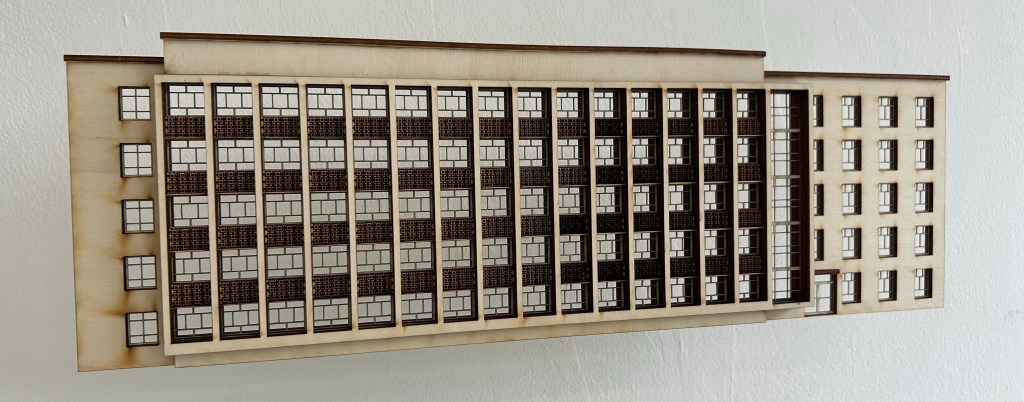
Abi Exon’s artwork is a scale model of the Byrom Street building, constructed in 1960 as part of the transition from Colleges into the Liverpool Polytechnic in 1970.
Charlotte Wood: There Has Always Been Someone Before You
Charlotte Wood pays tribute to female students of the past and present at the Liverpool School of Art within her models which re-create the likeness of students of Fine Art c.1920s-1930s, of Fashion and Textiles c.1960s, and of Graphics in 2023. The sculptures sit in front of images from the archive which inspired her designs.

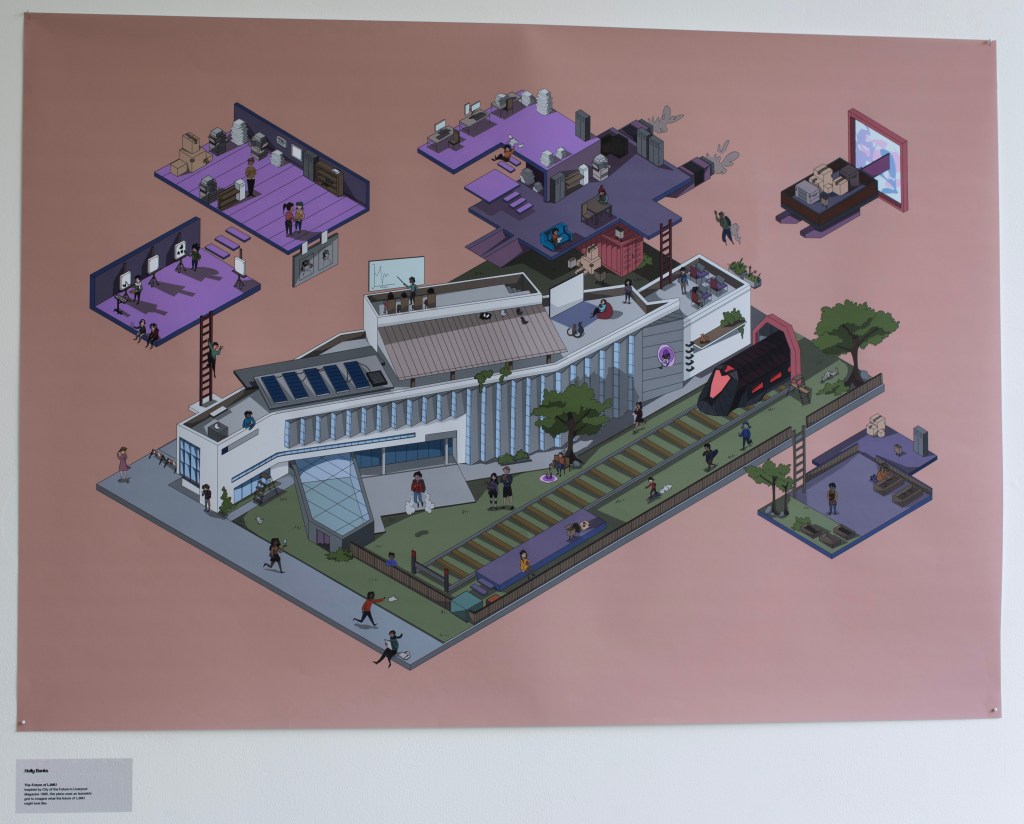
Holly Banks: The Future of LJMU
Inspired by City of the Future in Liverpool Magazine 1966 from our archives, Holly Banks uses an isometric grid to imagine what the future of LJMU might look like.
Viviana Caldeira: Evolution
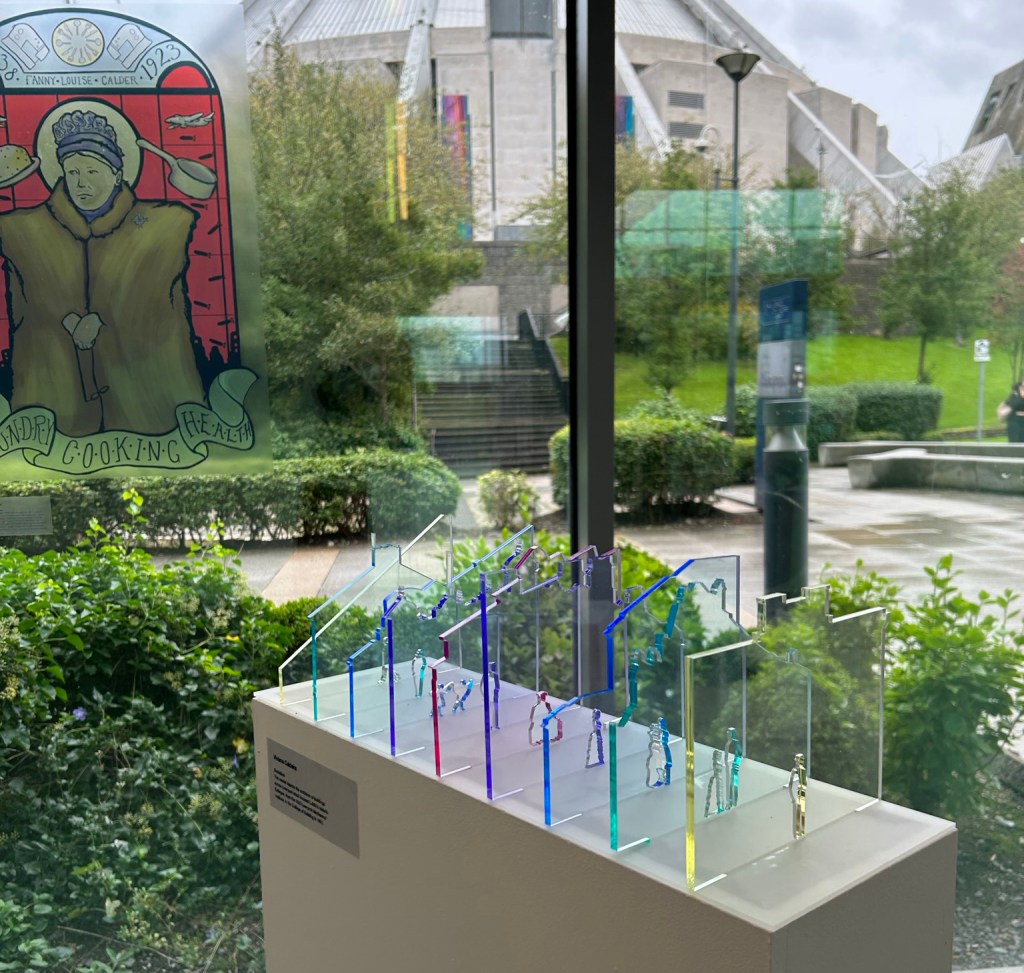
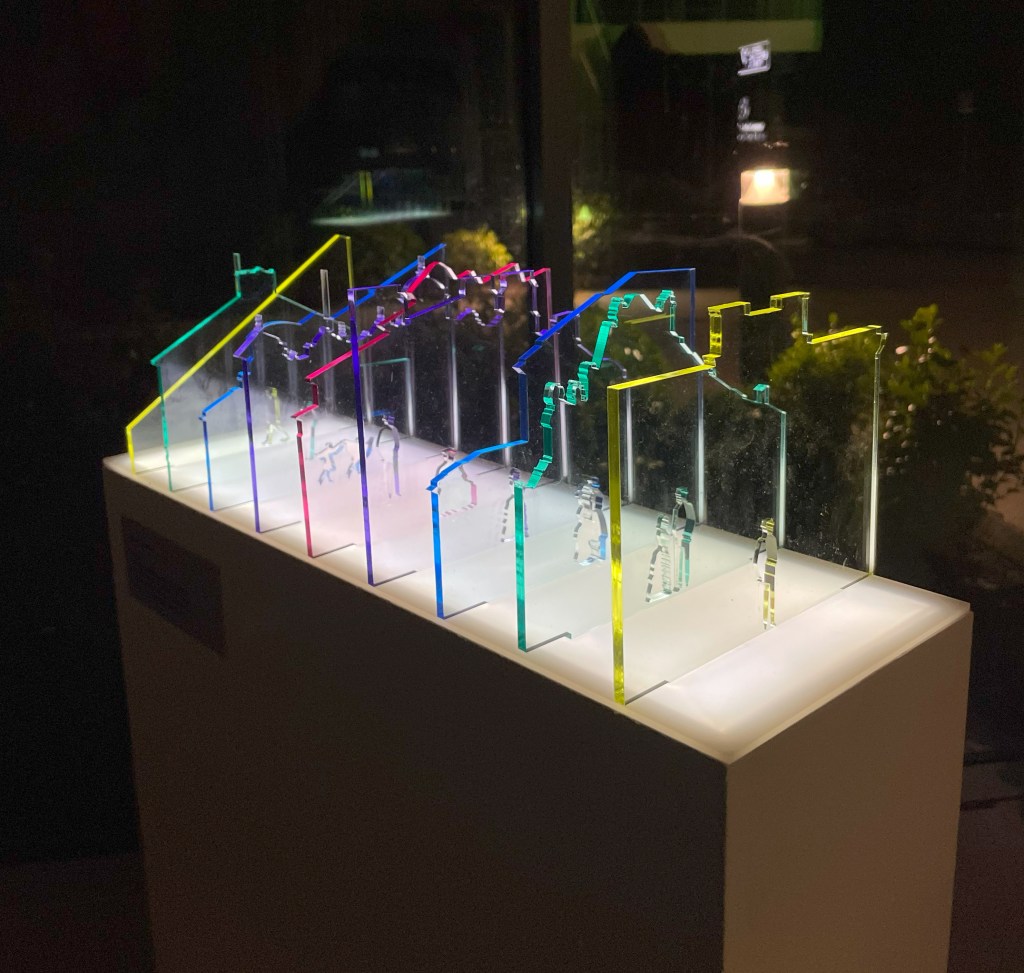
Viviana Caldeira’s laser-cut model depicts the Evolution of buildings across Liverpool which housed LJMU’s historic Colleges.
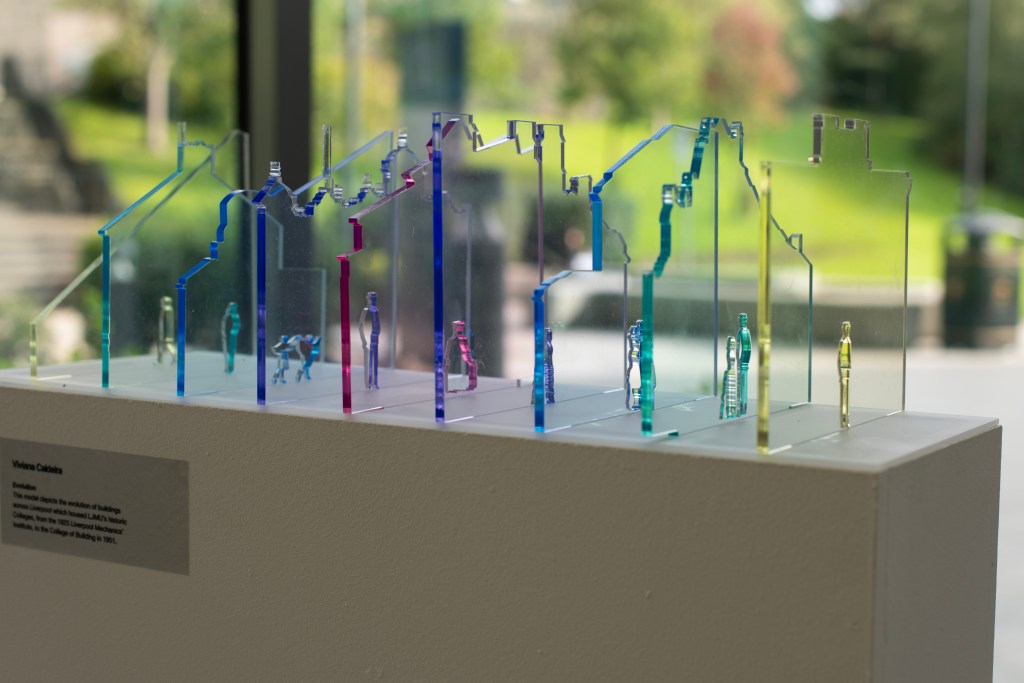
The buildings depicted are:
– Mount Street Building, 1837. Home to the 1825 Liverpool Mechanics’ Institute.
– 68 Hope Street, 1910. Home to the 1832 Liverpool School of Arts.
– Henry Cotton Building on Trueman Street, 2009. Home to LJMU Faculties of Science, Engineering, and Technology.
– The Royal Institution, Colquitt Street, built 1814 and depicted 1831. Home to the Liverpool School of Pharmacy, the Nautical College, F L Calder College of Domestic Science, and more.
– The Liverpool Sailors’ Home, Canning Place, 1852. Home to the 1852 Liverpool Nautical College.
– Dowsefield Hall, depicted 1958. Home to F L Calder College of Domestic Science.
– The Hazels, built 1764 and depicted 1945. Home to the 1945 C F Mott College for Education.
– Clarence Street Building, 1950. Home to the 1951 College of Building.
Installation and Launch
After over a year of hard work from our students and staff, the exhibition came together!
First year Graphic Design and Illustration students materialised their semester of archival research from 2022 into artworks for selection, critique, and amendments in early 2023, while the SCA team and School of Art staff co-ordinated the exhibition logistics throughout the year.
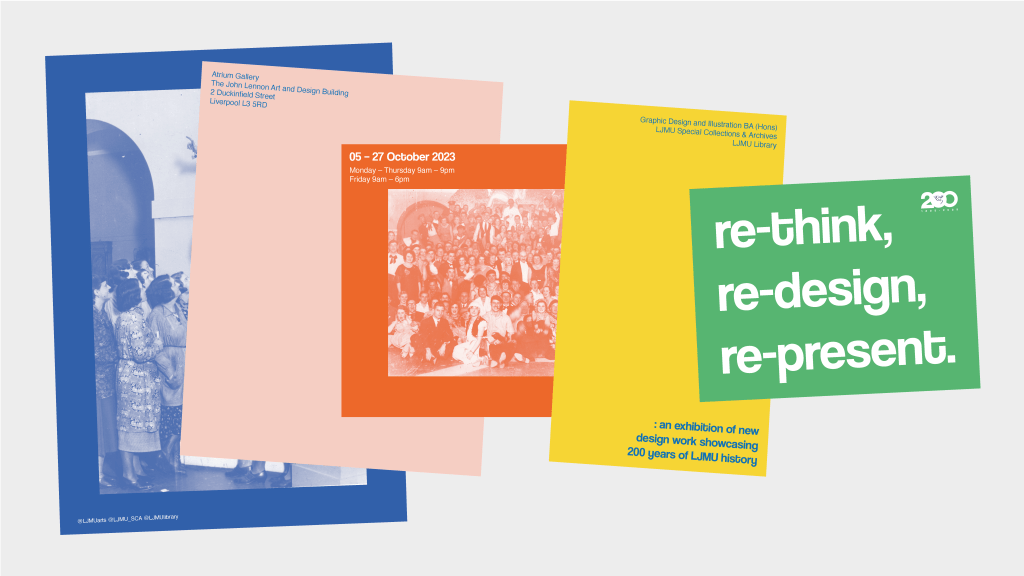
This included launching a competition for a third year Graphic Design and Illustration student to design the branding for the event. The winner was Ellie Shirley, who produced some fantastic artwork which we’ve been using to promote the exhibition launch.
Special Collections & Archives helped students learn to write interpretation text labels for their own artwork, a valuable skill for anyone who is interested in a future in curation. These were edited by the Archivists and printed in-house by the School of Art staff.
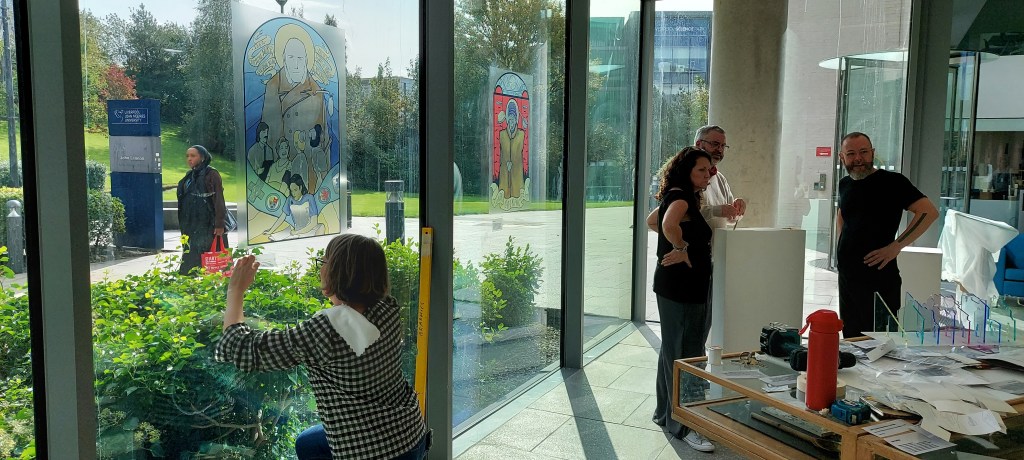
Custom plinths were created by Martin Gee, who was very patient to all of our ideas and last minute needs! And with only a few days before the launch party, all hands were on deck to install all fourteen works of art, select and display the archive material, ensure the case was lockable, and do any last minute printing and touch-ups to artwork.
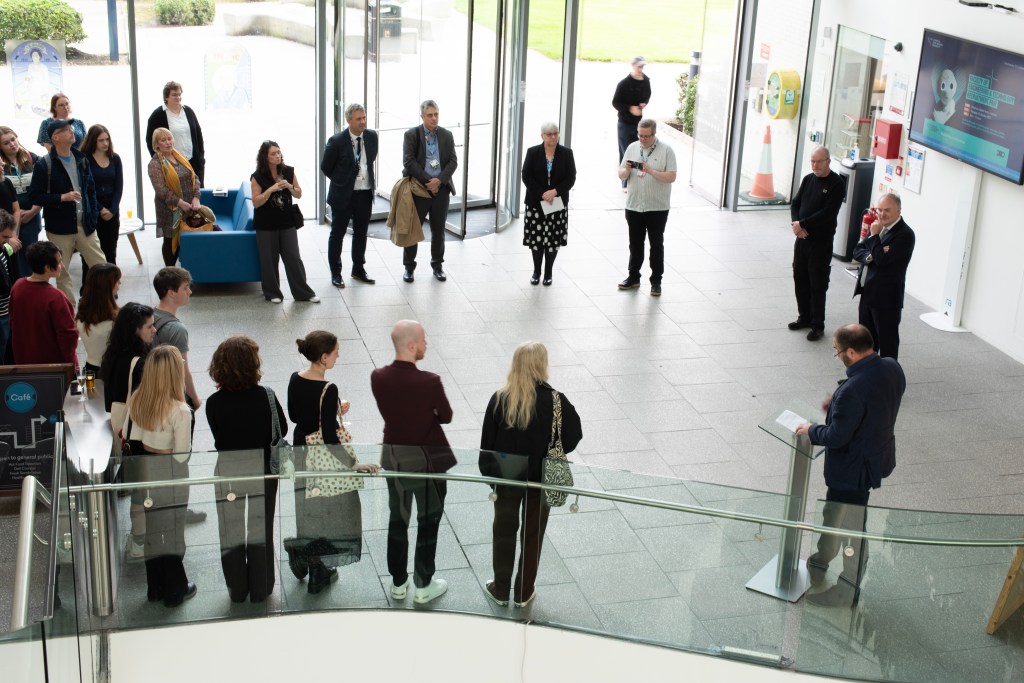
The launch event was well attended, with speeches from LJMU’s Vice Chancellor Professor Mark Power; Ian Wroot, Director of the School of Art and Design; and Heather Thrift, Director of Library Services, who all celebrated the creative and collaborative achievements of re-think, re-design, re-present.
Thank you to all of the students and staff who made the exhibition such a success. You should all be incredibly proud of your hard work and talent.
Christopher Olive, Bicentenary Project Archivist 2023
 LJMU Special Collections & Archives