
As part of our ongoing Bicentenary celebrations of 200 years of history at LJMU, we’re launching our own historical Bake Off to share the recipes written by our educational ancestors.
All skill levels and types of bakes are welcome, and creative liberty with the historic recipes is definitely encouraged. And even if you can’t bake, you can certainly come along to eat it!
If you don’t live local but you still want to get involved, please share any images of the baked goods you’ve made with us on social media by tagging @LJMU_SCA on Twitter/X or TikTok – we’d really love to see them!
The Historic Recipes
Although we find recipes throughout our many and varied collections, most of the recipes directly linked to LJMU’s history were published by or in association with the 1875 Liverpool Training School for Cookery, founded by Fanny Louisa Calder and her Committee of 58 Ladies. In 1920, after the purchase of the College by the City of Liverpool, it was renamed F L Calder College of Domestic Science in her honour.
All of these recipes are available to view in person at the archive, or online as a PDF on our catalogue using the following links:
- LJMUH/FLC/6/5/2 Centenary Recipe Book 1875-1975, 1976 (full PDF)
- LJMUH/FLC/13/3/1/1 Fanny Louisa Calder’s 1914 Economical War Cake (digitised)
- LJMUH/FLC/6/5/3 Plain Cooking Recipes, 1934 (partially digitised)
- LJMUH/FLC/6/5/5 Recipes for Use at the Cookery Classes 1888 (partially digitised)
- LJMUH/FLC/14/1/1/15 Household Cookery Recipes, Northern Counties Training College of Domestic Science with Handwritten Recipes by M E Robertson, c.1940s-1960s (partially digitised)
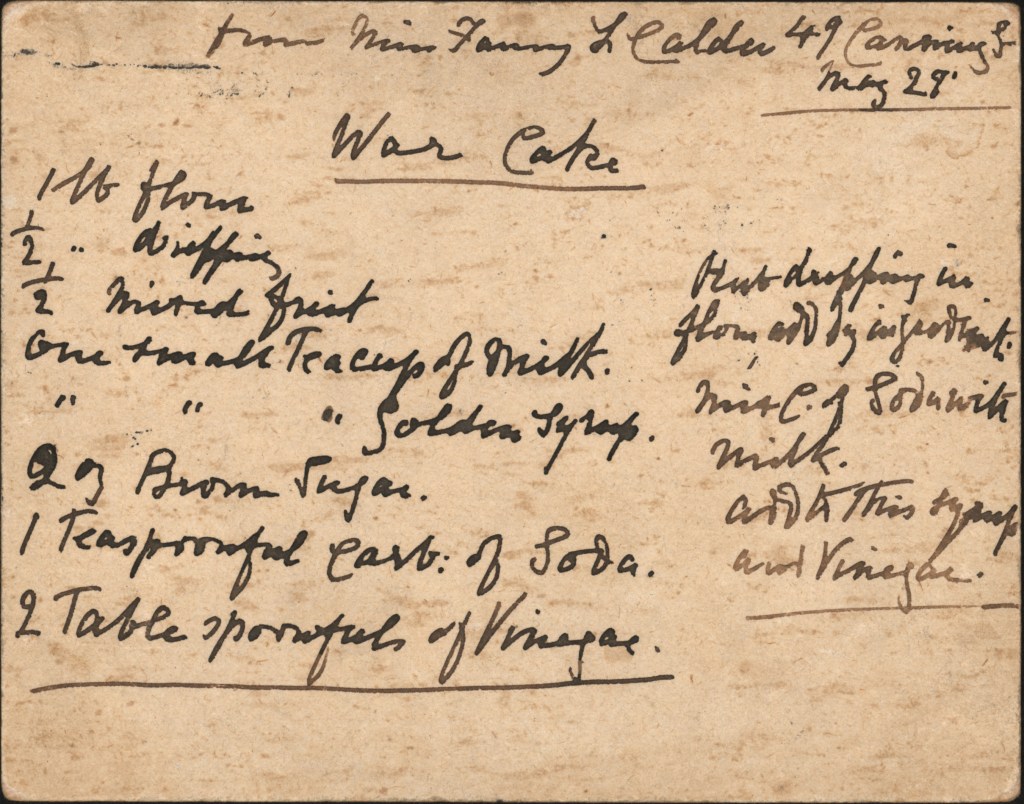
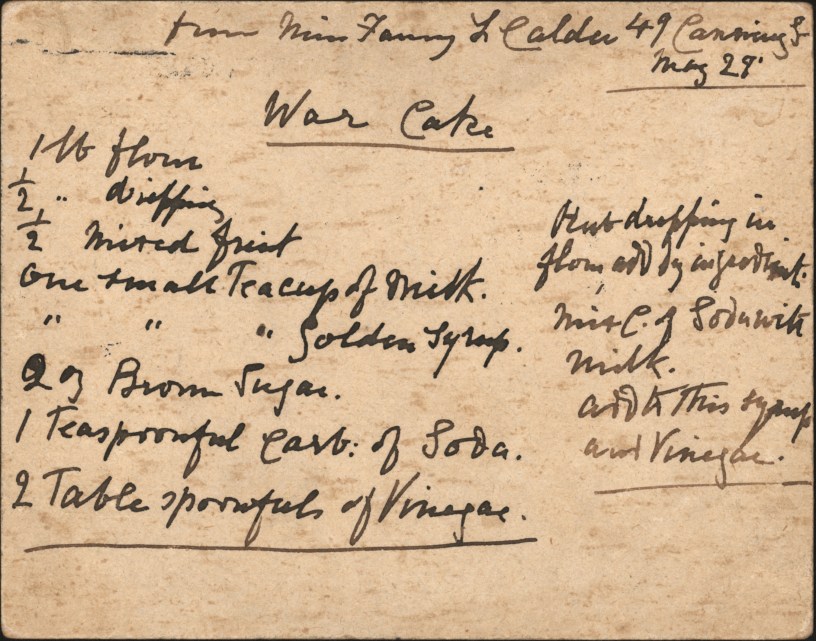
This includes the famous Economical War Cake recipe, written 29 May 1914 as an early response to the prospect of War on British domestic life. Although this original recipe uses animal dripping as a cheap fat replacement, a modern baker could substitute this for butter or margarine, as Hannah Jones illustrated in her Modern Day War Cake graphic poster and tea towel. You can find a copy of the original recipe with a transcription on our online catalogue using the reference LJMUH/FLC/13/3/1/1.
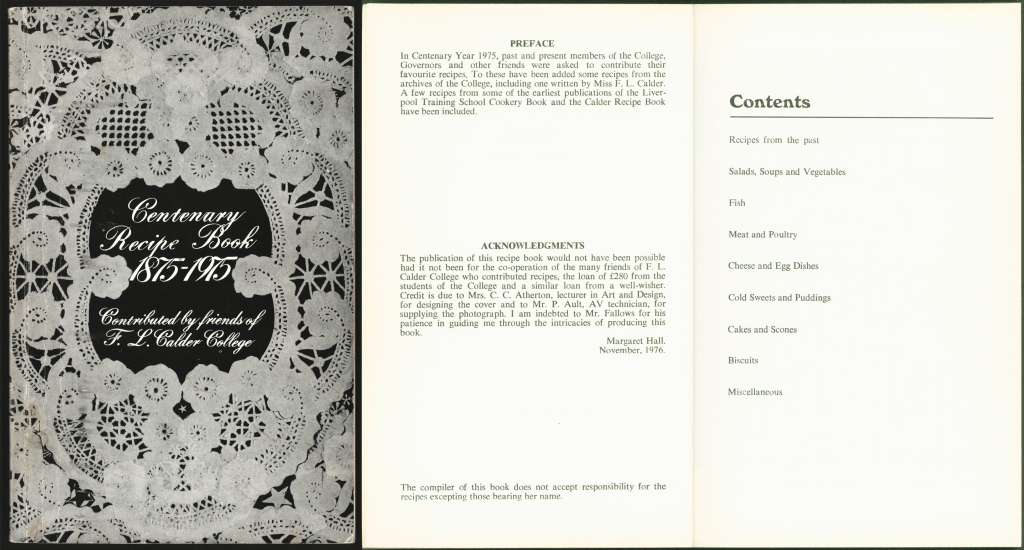
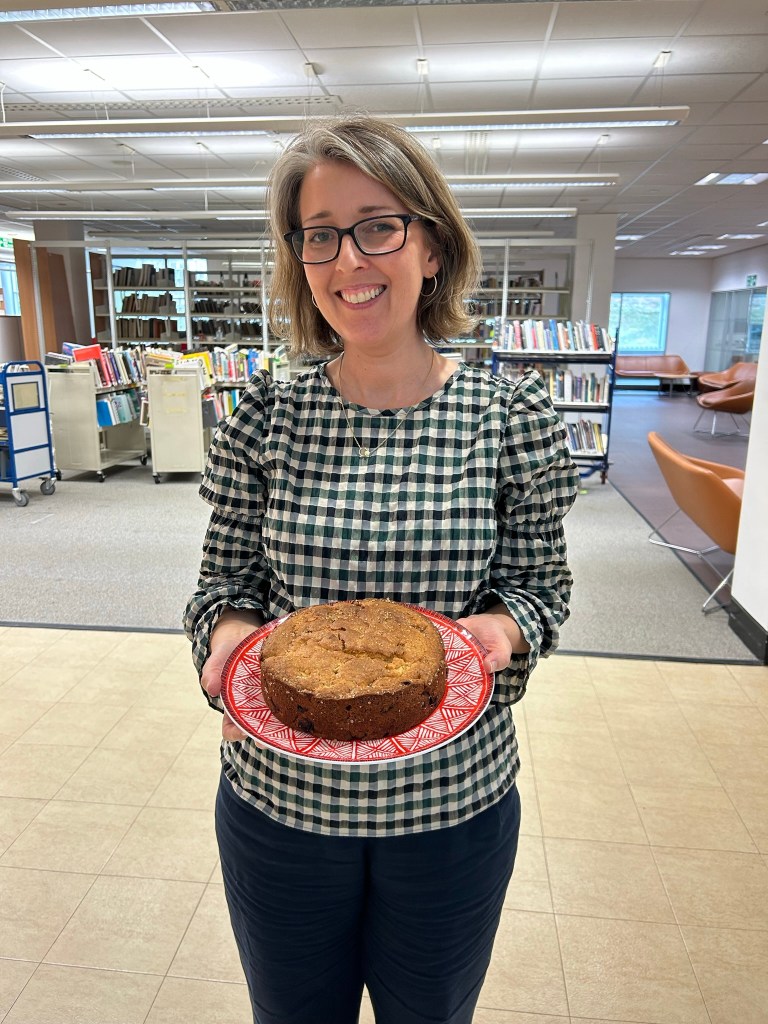
Although we have recipes published by the School as far back as 1888, most modern bakers will prefer to use the slightly more modern recipes published in 1976 within the Centenary Recipe Book: 1875-1975. This was a limited edition publication of both historic recipes, as well as new contributions by staff, students, alumni, and friends of the College, compiled by Margaret Hall to celebrate 100 years of F L Calder College. The full book is available online as a pdf on our catalogue using the reference LJMUH/FLC/6/5/2.
Susannah Waters, our current Head of Academic Services, has baked a brilliant first attempt at the Apple Cake recipe contributed by Susan J Halle of Runcorn. The SCA team collectively scored the recipe 7/10: very flavourful, but quite dry. You can watch her bake it and us rate it on our TikTok!
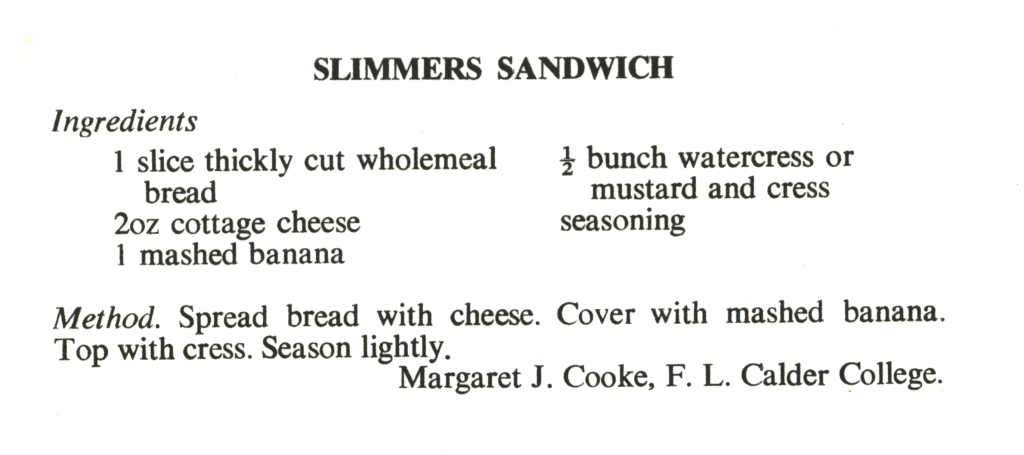
Although there are many very edible-sounding recipes within this book, there are also a number of dishes (particularly savoury and ‘miscellaneous’ dishes) which might only be for the more adventurous. Hall even warns readers with the disclaimer that she ‘does not accept responsibility for the recipes excepting those bearing her name.’
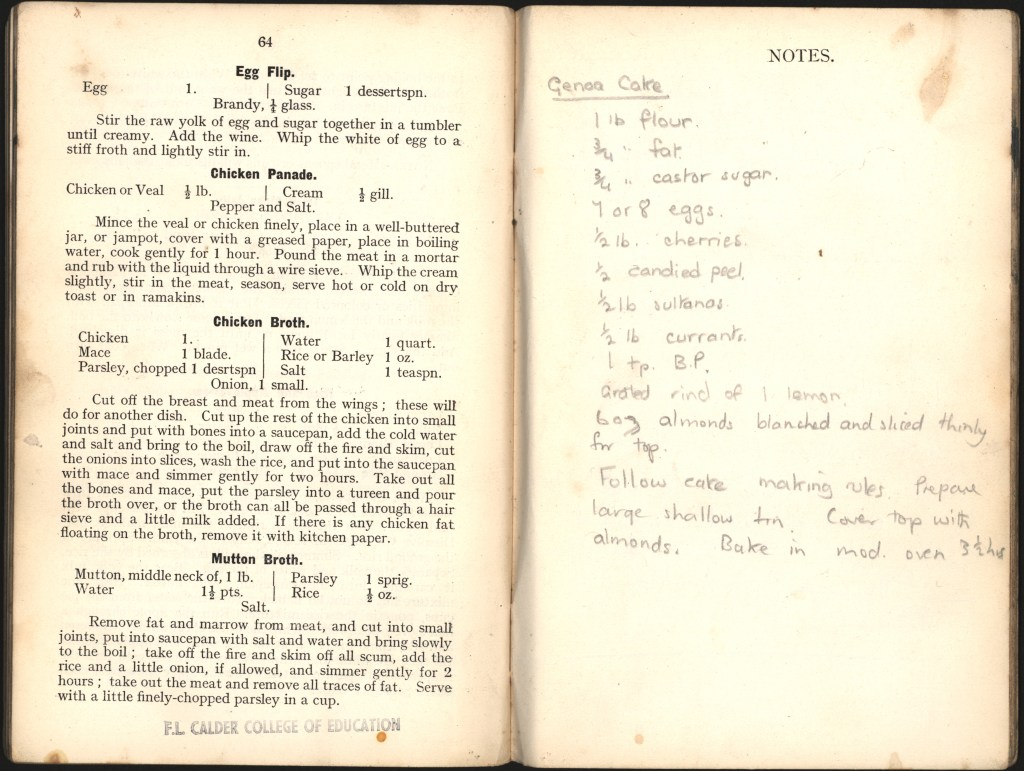
Up until quite recently, recipes were much shorter with more assumed baking knowledge than we expect from a recipe book today, and there were certainly no SEO-driven life stories written in to boost search engine results! This recipe written into the notes page of Household Cookery Recipes by M E Robertson, Principal of F L Calder College 1956-1972, provides only the ingredients for her Genoa Cake and then simply ‘Follow cake making rules.’ You can view her handwritten recipes and a transcription of her Genoa Cake recipe on our catalogue using the reference LJMUH/14/1/1/15.
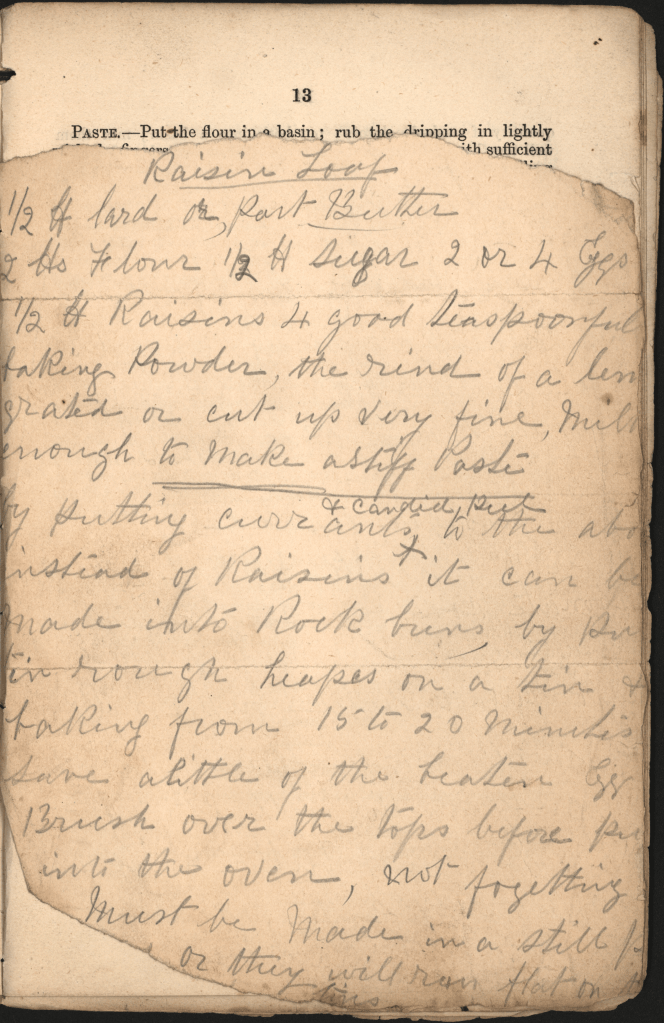
Other recipe books published by the College include the earliest publication: Recipes for Use at the Cookery Classes, Liverpool School Board, 1888, catalogue reference LJMUH/6/5/5. This shows manuscript recipes bound into the pamphlet, likely written by a student teacher. Students of Cookery were intended to be teachers themselves, originally being trained in the education of cooking skills (among other Domestic crafts) to pass practical instruction and help onto women in poorer districts of Liverpool as a form of early social service. This book was also sewn to LJMUH/6/5/4, 1893 Plain Cookery and Laundry Work Recipes by the Liverpool Training School of Cookery.
Even more challenging to make delicious is the recipes born out of interwar poverty in Liverpool. Plain Cookery Recipes 59th ed., published 1934 by the Liverpool Education Committee, was only made available to students of the City Technical School for Women and F L Calder College ‘For use in Elementary Schools and in Classes for Technical Instruction.’ Use the reference LJMUH/FLC/6/5/3 to view.
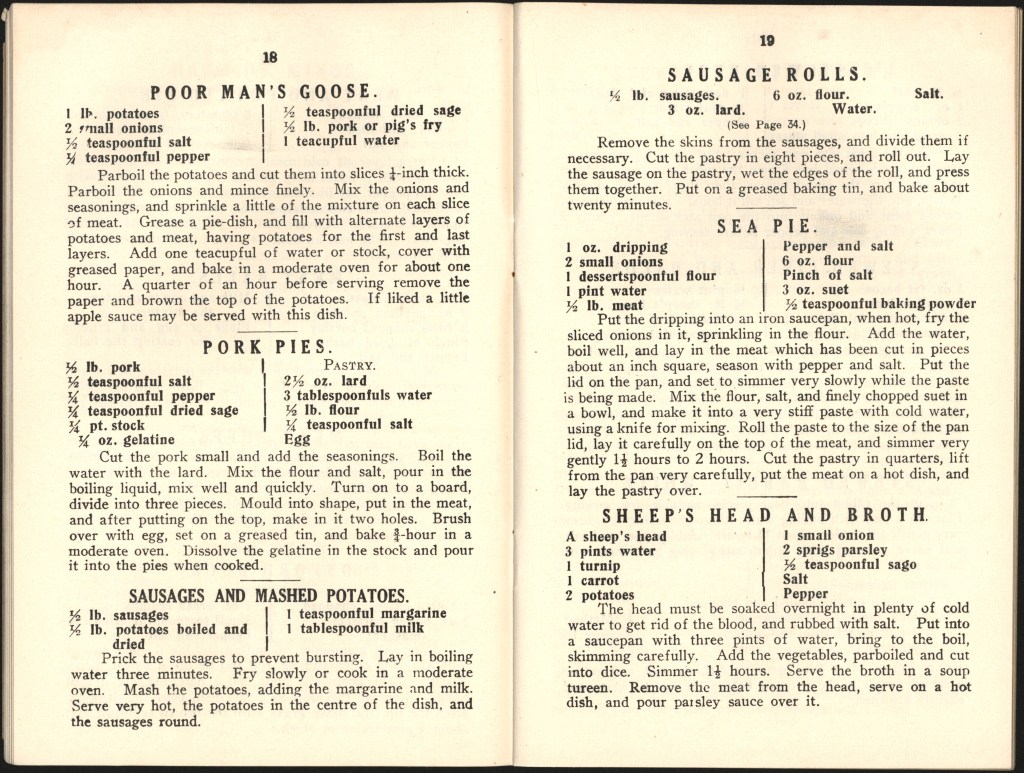
Many of the recipes, such as the ‘Poor Man’s Goose’ substituted expensive ingredients, like meat, for more readily available ingredients like potatoes, without taking into account the nutritional differences. During the 1930s, Liverpool was still suffering from the financial impacts of both the First World War and the subsequent Depression, and up to a third of working age men were unemployed. A 1936 study on Poverty and Public Health by G C M’Gonigle and J Kirby estimated that ‘nearly one half of the population of England and Wales subsist, to a greater or lesser extent, below the safety line of nutrition.’
Christopher Olive, Bicentenary Project Archivist 2023
 LJMU Special Collections & Archives