
Hello again, it’s Jade and welcome to blog number three!
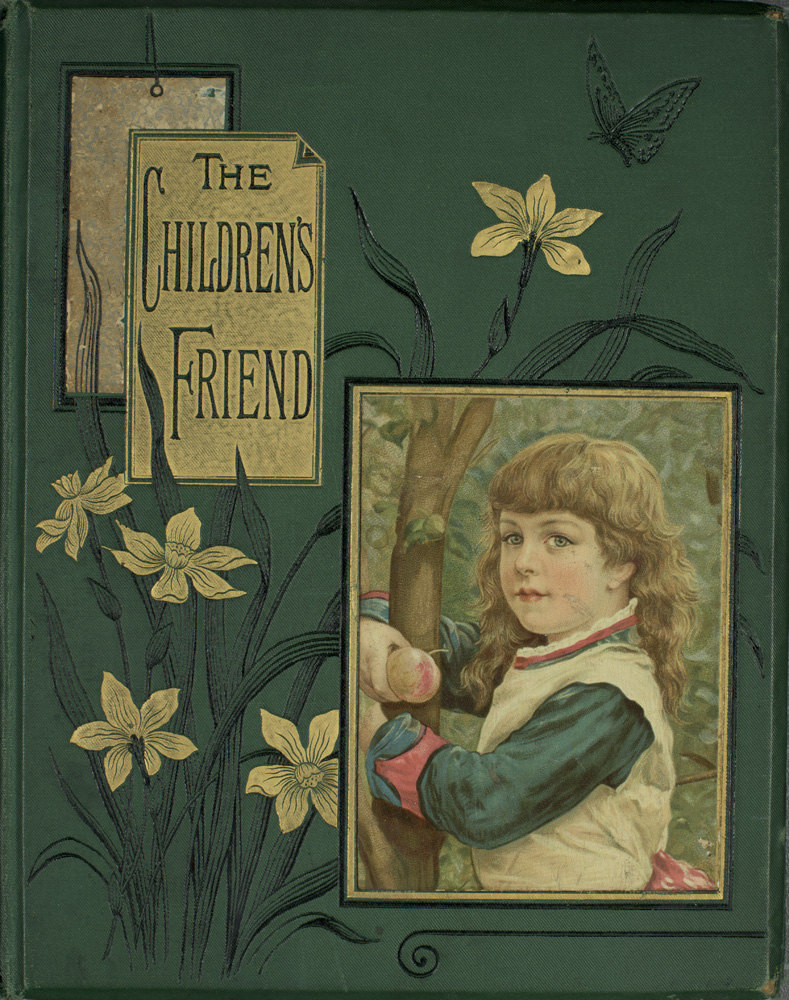
Now you know me as me, I feel we can get down to the nitty-gritty. As you may have noticed, the title is The Children’s Friend – the name of a magazine that ran from 1824 through to 1930. However, the important year is 1884. Still a prominent time in Victorian society the book offered values and stories to children across the nation. This is the year of the book that I have beside me as I write this blog.
I may have mentioned this, or I may have not, but my time in the igloo is limited as my contract is only 10 weeks long. This blog post marks the end of week three, leaving only seven weeks to wow you all with our project. Despite this I have taken the time (a whole two minutes of it) to count the number of issues that was in this book. Now, I probably should have known that this book would only contain 12 issues as it is a book that binds together a years-worth of MONTHLY magazines. I know, my intelligence overwhelms you.
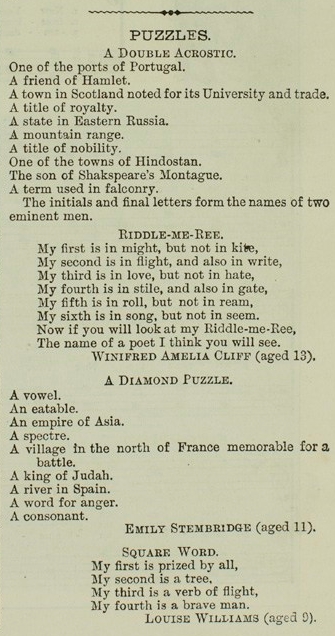
Moving on, every issue of The Children’s Friend includes a piece of music, some stories, some pictures of families and animals or even some artwork for biblical references. It also includes a puzzle page, provided on the second-to-last page of each issue. With this, I was thinking we could begin a competition of some sorts. I can’t offer anything in terms of prizes but it might be fun. Roisin and I certainly found it fun.
Just to give you all a little bit more information on the periodical: it was a magazine first published in 1824 and founded by a man named Rev. William Carus Wilson (1791–1859). Unfortunately, due to his nature and the content published in the first issues, he was best known for being the inspiration for the negative character of Mr. Brocklehurst in Charlotte Brontë‘s Jane Eyre. Wilson’s issues generally included dark tones with references to death, however, after Wilson’s death, his brother took over the magazine. With this take over came many more bright skies as he introduced more friendly stories and puzzle pages to be more relevant for Children at that time.
I remembered this book when working this week because Roisin and I got to work on Monday and that was it. The beginning of the end. We were shown how to collect metadata when digitising images from the books. There was so much. Luckily we had thought ahead and created unique and understandable codes that could be used for each image. For example, the first image that we used in The Children’s Friend was dubbed: C19_CHFR1884_01. This indicated that it was a 19th century periodical called The Children’s Friend published in 1884 and it was the first image. Smart, I know. It didn’t make the process go too much faster, though, because we were still sat at the computer constantly typing in the name, date, code, publisher, our name, file format, etc. this constant and we have so far managed to digitise and collect metadata for approximately 300 images, blast metadata!

Somewhere in the never-ending list on the excel spreadsheet sat the images that we had used from The Children’s Friend and it spiked my memories from a long time ago. ‘Twas the night before Christmas and all thro’ the house… I’m kidding. It was actually three weeks ago on our first day and we didn’t truly have a clue what was going on but we turned up to work and there was a small pile of books awaiting our arrival. We were told to familiarise ourselves with the periodicals provided and so we did. However, not to the specification of our job role, being to find images of animal depictions. No. instead, we found the puzzles at the back of each issue of The Children’s Friend and worked through them. Our favourite being the ‘Riddle-me-Ree’ puzzle. You may call the exercise childish but we call it a ‘well thought-out colleague bonding day’ because that’s what it was, a day of children’s puzzles, which, might I add, are quite hard. Especially, for example, when you don’t know the names of many 19th century poets. The ever-so-slightly disheartening part is that some of these puzzles have been submitted by their readers (i.e. children) and took us quite a while to complete. Note: we are over the age of 20. So, thank you for that one, Ella Rendle, aged 93/4.
As mentioned, there are twelve issues, meaning twelve puzzles and with a hearty seven weeks left I was thinking we could do two posts each week. You guys can comment and tell me what you think about that idea and for this week I will post up two puzzle pages. I might even split it so that they are spread out in the week.
The way this could work is; If I post up the puzzle, you guys can comment on the blog with your answers and then a few days later I will post another puzzle page – which also has the answers to the previous issue’s puzzles – to tell you if you managed to work it out or not!
Adding to this thrilling ride of children’s magazine inclusions, the issues each have a page dedicated to a small piece of music. This is located at the back of the book and I was thinking that we could liaise with some musically inclined personnel to reproduce the music. Personally, I can’t read music, hence being an intern on a media related job and I think it would be lovely to hear the music given to young Victorian children. It will give us so much insight into the Victorian era and we might even use a piece or two in our exhibition! You can help us choose!
I hope you enjoy, and don’t forget to comment!
Jade 🙂


I can do the Riddle-Me-Ree (Milton), but don’t think I have the time to attempt the others… Can’t believe the children made them up!
Emily
LikeLiked by 1 person
I am trying my best with the first one, but even with the help of Google, I haven’t cracked it yet!
LikeLiked by 1 person
Love the idea of the riddles but have to say I’m struggling – please put me out of my misery and post up the answers
LikeLiked by 1 person