
Hello!
We are now coming to the end of our 3rd week as archives interns. This week has been entirely consumed with metadata collection for the online portfolio of Victorian animal images. For each thumbnail copy of our selected images that have been carefully arranged with a reference code into a spreadsheet, we have had to enter a short description. This process is for logging and record-keeping purposes only, yet it is highly important. Since the image has been taken from its original source, i.e. the Victorian periodical, and transferred to an electronic source, it needs to be traceable. Otherwise, considering the large quantity of images we have attained (approximately 310!), things could get a little confusing! Being a bit of a book geek as well, I like to think of it as a way of not forgetting the image’s roots. Despite our highly technological advancements, the true magic is not that these images will be made accessible online, but that they come from the pages of books, journals, broadsheets, and magazines over two-hundred years old, and are hand drawn! We are very nearly finished with the metadata phase of our project and I am looking forward to beginning more in-depth research of animals and their cultural influences in Victorian life for our forthcoming exhibition.
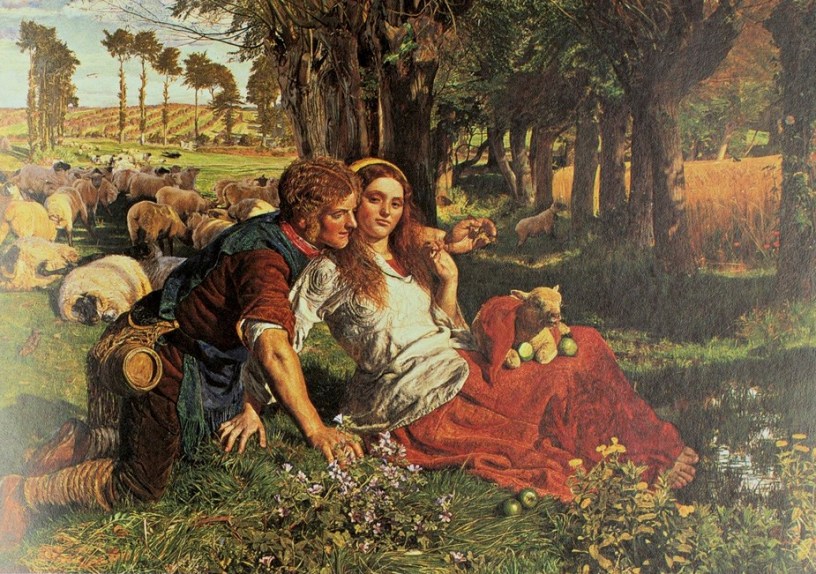
To add a personal touch to this blog, each week I have selected a “Favourite Image of the Week” and described what I like about the image. This week I am choosing to present “The Hireling Shepherd” by William Holman Hunt.
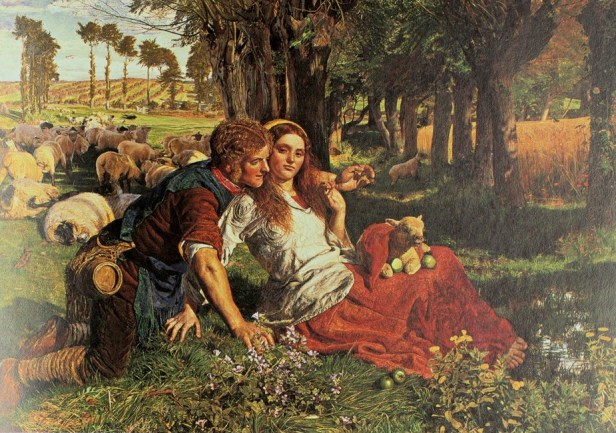
This image has not come from a periodical, and it is not particularly my ‘favourite’, but what it led me on to discover, I find fascinating! The artist, William Holman Hunt, is one of the three founders of the Pre-Raphaelite Brotherhood. The other two originators are painters John Everett Millais and Dante Gabriel Rossetti. The Pre-Raphaelite Brotherhood is a collection of English painters, poets, and critics, founded in 1848, who emphasised and encouraged Romanticism in the arts. Romanticism incorporates individualism, emotion, glorification of nature, aesthetic appreciation and experience, and a focus on the medieval. On looking into the art of the Brotherhood, I noticed how much of it depicts beautiful women; typical female qualities equating to many aspects of Romanticism. What initially drew me in to “The Hireling Shepherd” was the young red-haired woman’s relaxed, superior disposition in comparison to that of her male counterpart. He is eager and seeking her attention whilst, although reclining towards him, the woman appears disinterested, or rather, she will engage with him when ready. She has attitude! I was curious to know who she was. Some online research told me her name was Emma Watkins. My interest in Emma Watkins is what lured me into discovering the Pre-Raphaelite Sisterhood.
The Pre-Raphaelite Sisterhood are women who modelled for, and are associated with, the Pre-Raphaelite Brotherhood. The most famous of these women include Jane Morris, Elizabeth Siddal, Fanny Cornforth, Annie Miller, and Euphemia Millais. These women were considered ‘Pre-Raphaelite stunners’ and were sought out and painted by the Brotherhood for their striking features; large, lidded eyes, long necks, and thick hair. Often originally poor and uneducated, these women became important members of the upper-class network of arts and literary figures, as well as the wives and lovers of the Brotherhood. The women’s looks vary, meaning no definite ideal of beauty. Elizabeth Siddal presents fiery red hair and pale skin, and though she is often considered to have a ‘plainer’ face than the rest, this assumption adds to her allure as she is depicted in paintings with a sombre expression and intense but lazy gaze. Siddal was the wife of Rossetti and she appeared in many of his early works. Despite this, the painting she is probably most famous for modelling in is Ophelia by Rossetti’s fellow Pre-Raphaelite, Millais.
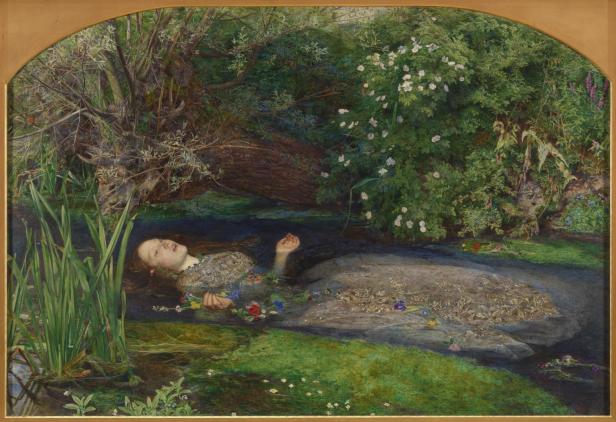
Siddal died tragically and Rossetti found a new muse with whom he seemingly fell in love with; Jane Morris, the wife of poet and textile designer, William Morris. William Morris was closely associated with the Pre-Raphaelites and apparently respected the relationship between Rossetti and his wife as a profound friendship.
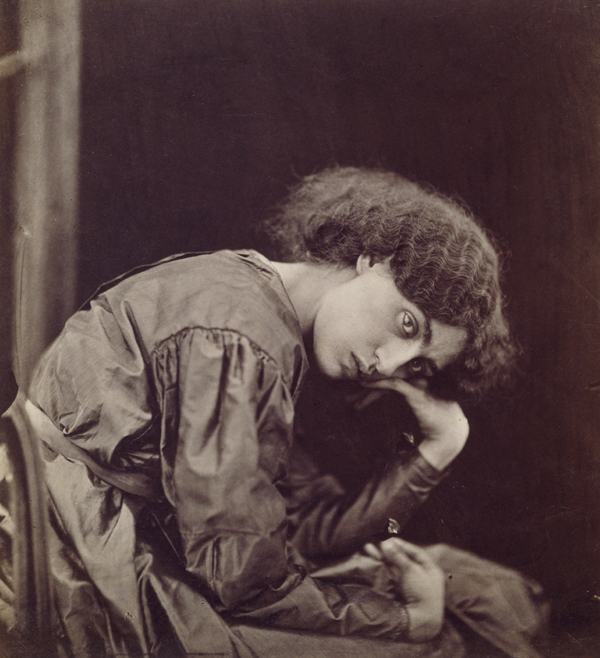
Unlike Elizabeth Siddal, Jane Morris represents brunette beauty with her dark hair and thick brows. She appears countless times in Rossetti’s work. She has a magnificent strong and brooding face, though from seeing real-life photographs, it is obvious that Rossetti has glamorised her appearance. Nevertheless, I find Jane’s face in both painting and photo extremely enticing. She has a mysterious, silent aura about her which Rossetti communicates exceptionally. She is the essence of femme fatale, subtly intermingled with an air of innocence and blasé.
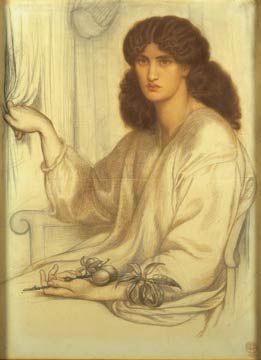
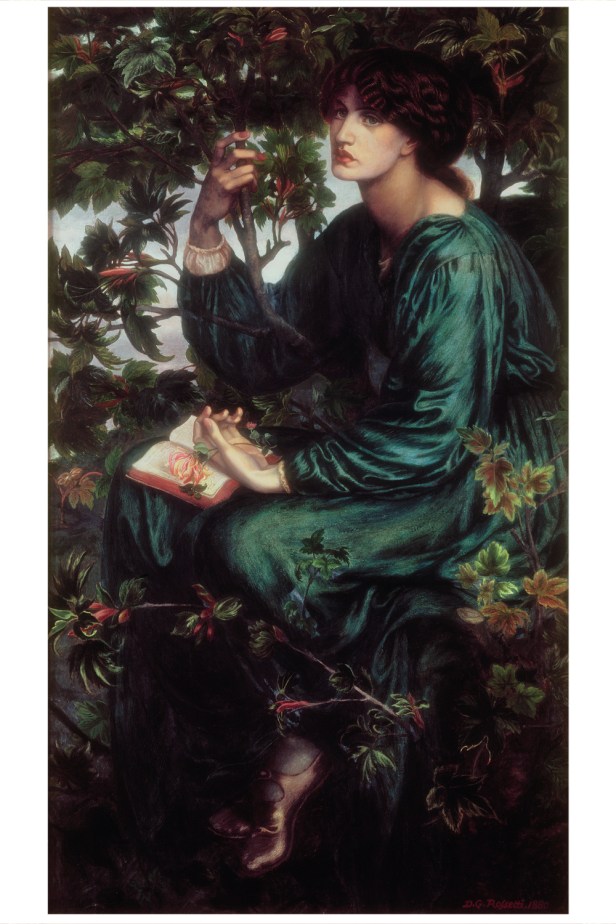
Jade and I viewed one of Rossetti’s largest pieces of art Dante’s Dream on the Day of the Death of Beatrice in the Walker Art Gallery last week. I only happened to find out afterwards however, that the woman posing as Beatrice in the centre is Jane Morris. I was confused as the woman in the painting has red hair and discovered that Rossetti did this as a tribute to Elizabeth Siddal. He combined the two greatest loves and muses of his life.

I have only briefly touched on the Pre-Raphaelite Brotherhood and Sisterhood. The network of art and relationships involved is actually immense and highly complex. There are many other intriguing women with interesting stories and Rossetti had lots of romantic affairs. Millais also married a woman who was already taken by another man! I got entirely immersed in it all and spent three afternoons researching and fawning over the paintings. I have taken out a book from the library entitled “Dante Gabriel Rossetti and Jane Morris: Their Correspondence”. It is a collection of the letters Rossetti and his affectionately named “Janey” exchanged. I am just a hopeless romantic! I was so thrilled and excited to see how art, so patriarchal in Victorian times, was essentially inspired and produced on the basis of these women. Although a feminist perspective could argue that it merely focuses on their physical worth, I see beyond this to the strength, history, and enigma of these women in the paintings. Through art they were brought to the higher state they deserve than they would have been in everyday Victorian life.
Roisin
x
Sources
Jacobi, C. (2006) William Holman Hunt: painter, painting, paint. Manchester: Manchester University Press
 LJMU Special Collections & Archives
Lovely images – I’ll try and find the white Pre-Raphaelite hound I found a few weeks ago, he was very handsome!
LikeLike
Found my favourite dog – a study in white!
.jpg)
LikeLike